Ed Atkins
Ed Atkins
2 April – 25 August 2025
Tate Britain, London
Ed Atkins is best known for his computer-generated videos and animations. Repurposing contemporary technologies in unexpected ways, his work traces the dwindling gap between the digital world and human feeling. He borrows techniques from literature, cinema, video games, music and theatre to examine the relationship between reality, realism and fiction.
This career-spanning exhibition features moving image works from the last 15 years alongside writing, paintings, embroideries and drawings. Together, they pit a weightless digital life against the physical world of heft, craft and touch. Atkins uses his own experiences, feelings and body as models to explore themes of intimacy, love and loss. For Atkins, the exhibition represents a reimagining of the messy, unravelling realities of life.
'My life and my work are inextricable. How do I convey the life-ness that made these works – my life-ness – through the exhibition? Not in some factual, chronological, biographical way, but through sensations. I want it so the more you see, the richer, more complex, less authored, less gettable things become.'
—Ed Atkins
The first work you encounter is a machine-embroidered patchwork of stained linen stretched over acoustic foam. The barely visible text is a diary my Dad kept while undergoing cancer treatment, bluntly alphabetised into dispassionate nonsense. Throughout the show, embroideries act as material counterweights to the digital videos. Found fabrics, spoiled by use, are stretched to video aspect ratios and covered with unfathomable lists. Where the videos project, the embroideries absorb, putting out silence.
The videos in this room, Death Mask II and Cur, are two of my earliest experiments. I made them right after finishing art school at The Slade. As soon as I started editing footage and sound together on my laptop, I fell in love with the process – what it could contain and the feelings it could express.
I wanted the subject of the camera to recede, allowing the editing, sound, and effects to come to the fore. I started making videos that explored how they were made and how they structured sentiment, confessing their artificial nature while remaining oddly ignorant of it. Slickly edited digital footage interrupted by messy reality in the form of excess, frustration and accident, fragments of unknowable sensation.
I was thinking a lot about the material and emotional extremes of death when I made these videos, as well as the texture of grief. My Dad had recently died, which suffused my life with loss. I wanted to find a vessel and a language to contain these feelings. I began to think of high-definition digital videos as corpses – vivid, heavy and empty. These early short videos are more or less horror films.
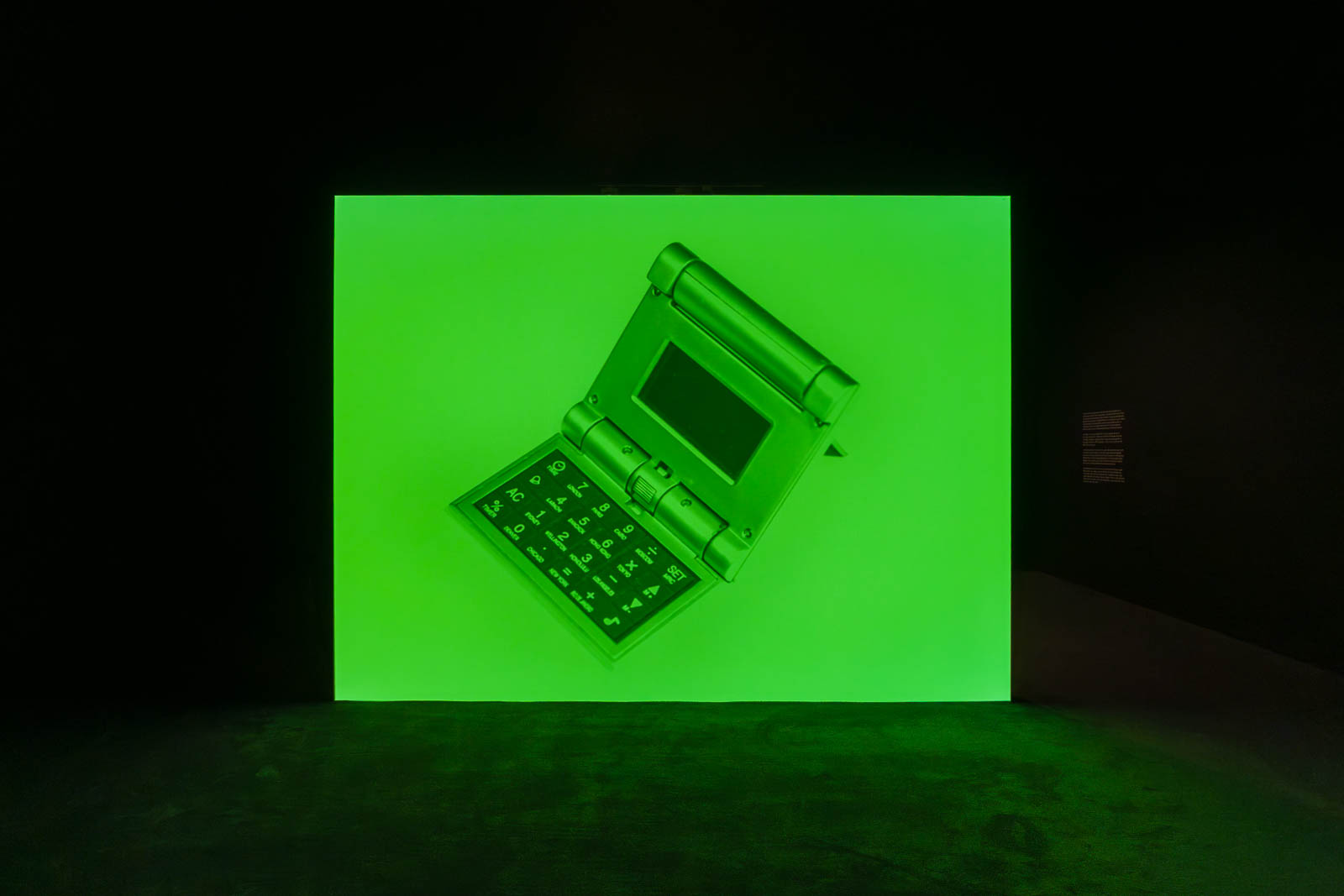
Death Mask II, 2010 Video and sound Death Mask II is all synth noise, vivid, posterised colours, jump cuts and weird advertainment. I wanted to present a montage of sensation, desire, and generic familiarity. To both entice and repulse. I pined to reanimate the dead, to make videos that were necromantic. Riz Ortolani wrote the music that accompanies the repeated unfolding clock-calculator. It was composed for Ruggero Deodato's low-budget horror film Cannibal Holocaust (1980). The music is sickly and sweet – innocuous for the genre. It's also very catchy.
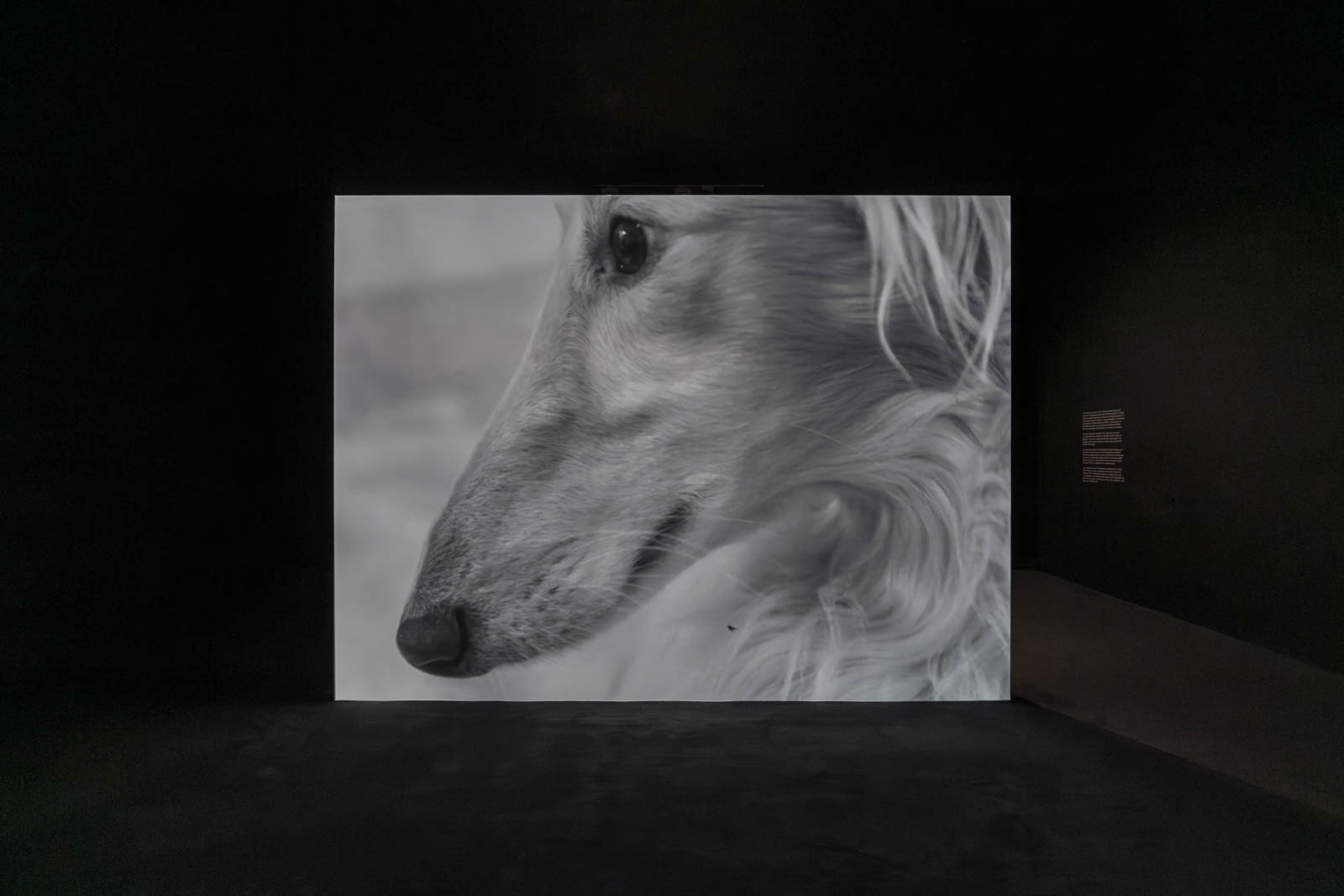
Cur, 2010 Video and sound Cur is a very intimate video that quickly sheds its specificity in order to foreground its construction. As well as using cliched emotional cues and tropes, this happens through performative (deliberate) 'accidents'. Autofocus racks badly, lens flares are sought and dwelled on, and audio blurts and cuts unceremoniously. I lean hard on these signifiers of supposed authenticity, forcing or markedly faking them. This use of mocked-up accidents is something that runs through all my work as a kind of confession or double-speak.
Hisser is one of my first entirely computer-generated videos. It was inspired by reading a news story about a man in Florida who went to bed one night only for a sinkhole to open under his bedroom. The earth swallowed him up, and his body was never recovered. I started to fantasise about every story ending like this. Sinkholes opening up abruptly under beds throughout history, throughout literature and cinema. This idea attracted and consoled me.
The video is repeated across three screens of different sizes. The bedroom's dimensions are modelled to a 16:9 ratio, so it fills the screens perfectly. There's a confusion of scale: the scene appears like a theatre stage, or an elaborate dolls house with one wall removed. The plasticity and reproducibility of digital video is underscored by the scaled repetition.
The computer-generated character is a customised stock figure from the online 3D marketplace Turbosquid. The character's facial movements and speech are mine, recorded and mapped using rudimentary performance capture technology. So I am in there too, performing, wearing the figure like a mask or a skin.
Hisser brims with things I wanted to exorcise. Feelings I wanted to see, ordeals I wanted to put the character through. I wanted him to apologise and to be punished, to suffer. It's around this time that I started calling the characters in my videos 'surrogates' or 'emotional crash-test dummies'. They can cope with things that I cannot. Although our relationship isn't literal or 1:1, this surrogate is a version of me. The things that happen to it are rehearsals of the unimaginable. O, to be swallowed by the earth and never retrieved.
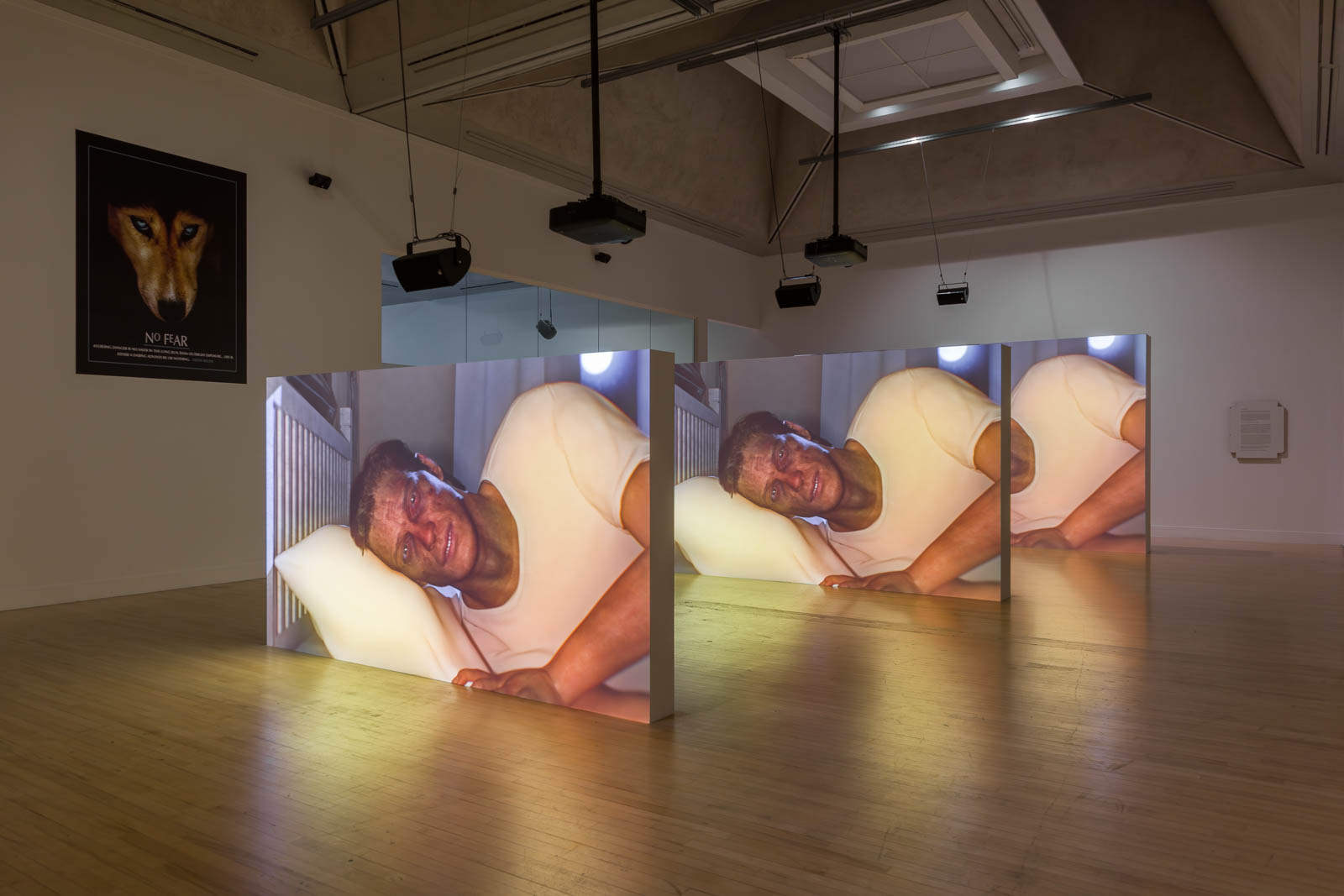
Hisser, 2015 Video projection with 5.1 surround sound 21 minutes 51 seconds To be installed a minimum of twice. There is no maximum limit. For example, 'Hisser' could be installed fifty times on every floor of a fifty floor apartment block Edition of 6 + 3AP
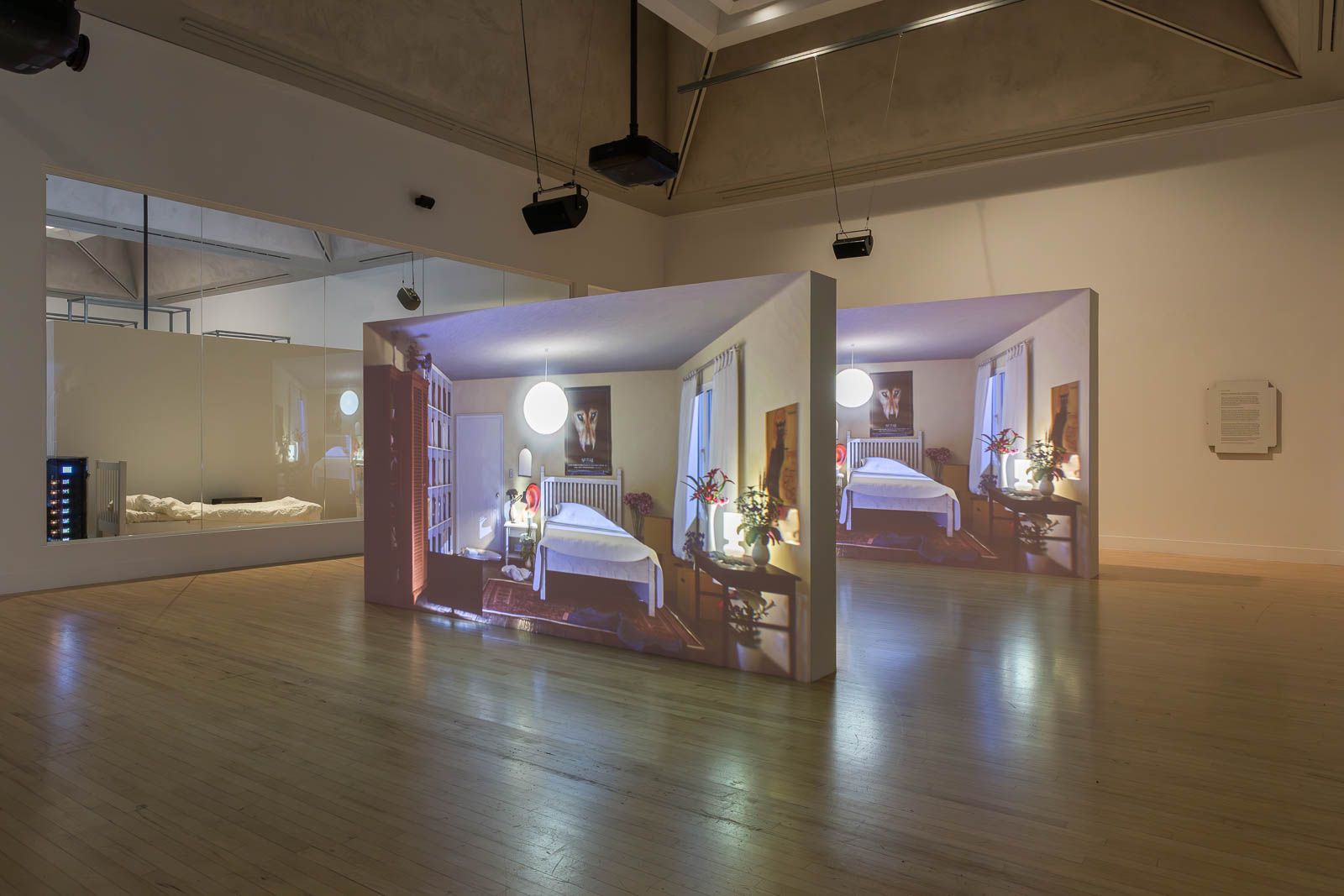
Hisser, 2015 Video projection with 5.1 surround sound 21 minutes 51 seconds To be installed a minimum of twice. There is no maximum limit. For example, 'Hisser' could be installed fifty times on every floor of a fifty floor apartment block Edition of 6 + 3AP
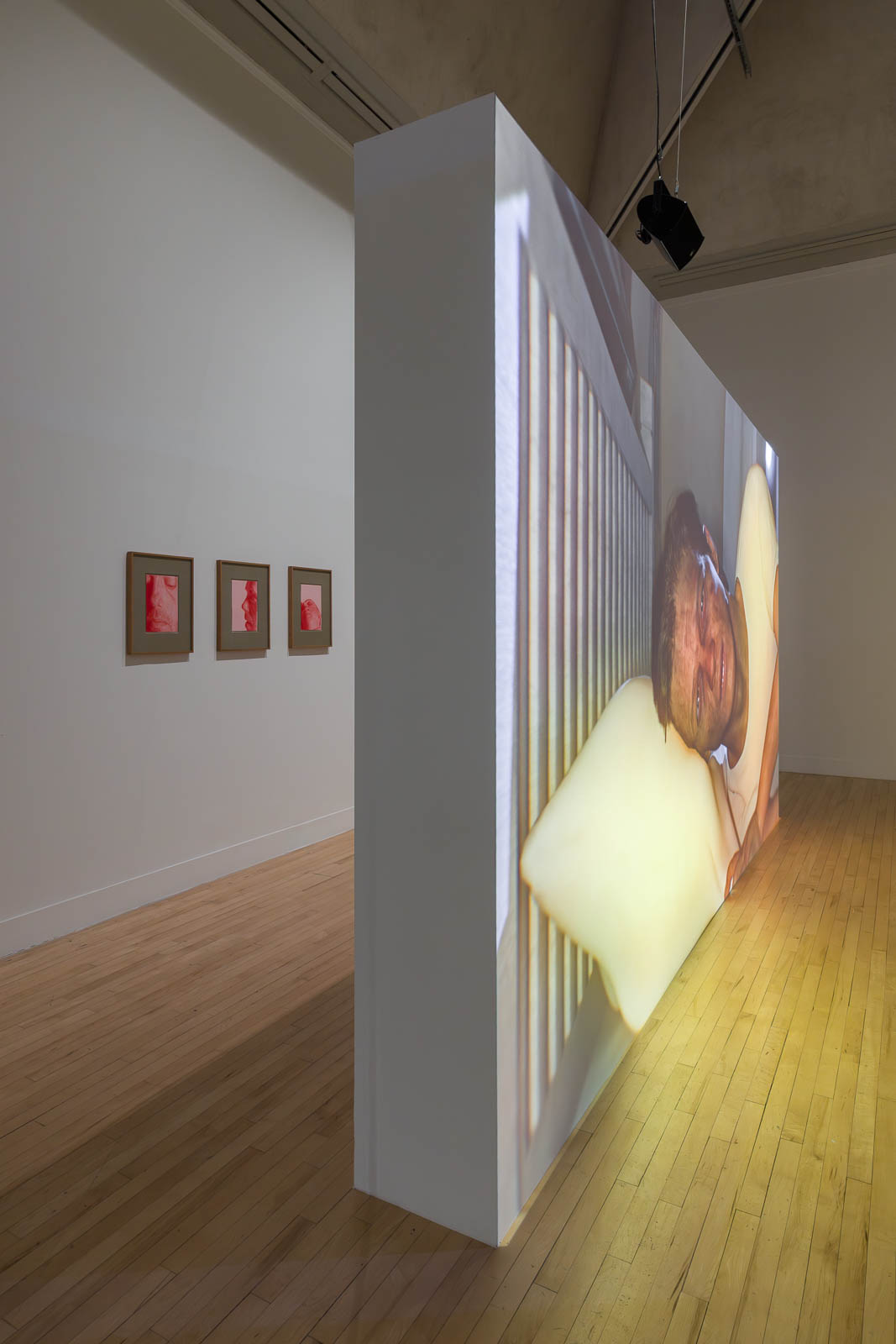
Untitled, 2023 Pencil on paper This is a self-portrait, one of several in the show. It took a long time to reintroduce drawing into my practice. Eventually, I embraced the self-evident connections between drawing and my videos – questions of representation, attention and labour. I thought I'd be straightforward about the self-portraits: make them look traditional and somewhat technically impressive, as well as kind of grotesque. I loathe my body and the way I look. I am often entirely destroyed by an encounter with an image of myself. The intense scrutiny required to draw these images offered a kind of therapeutic distance. As a thing to copy, I could stare at myself comfortably for hours.
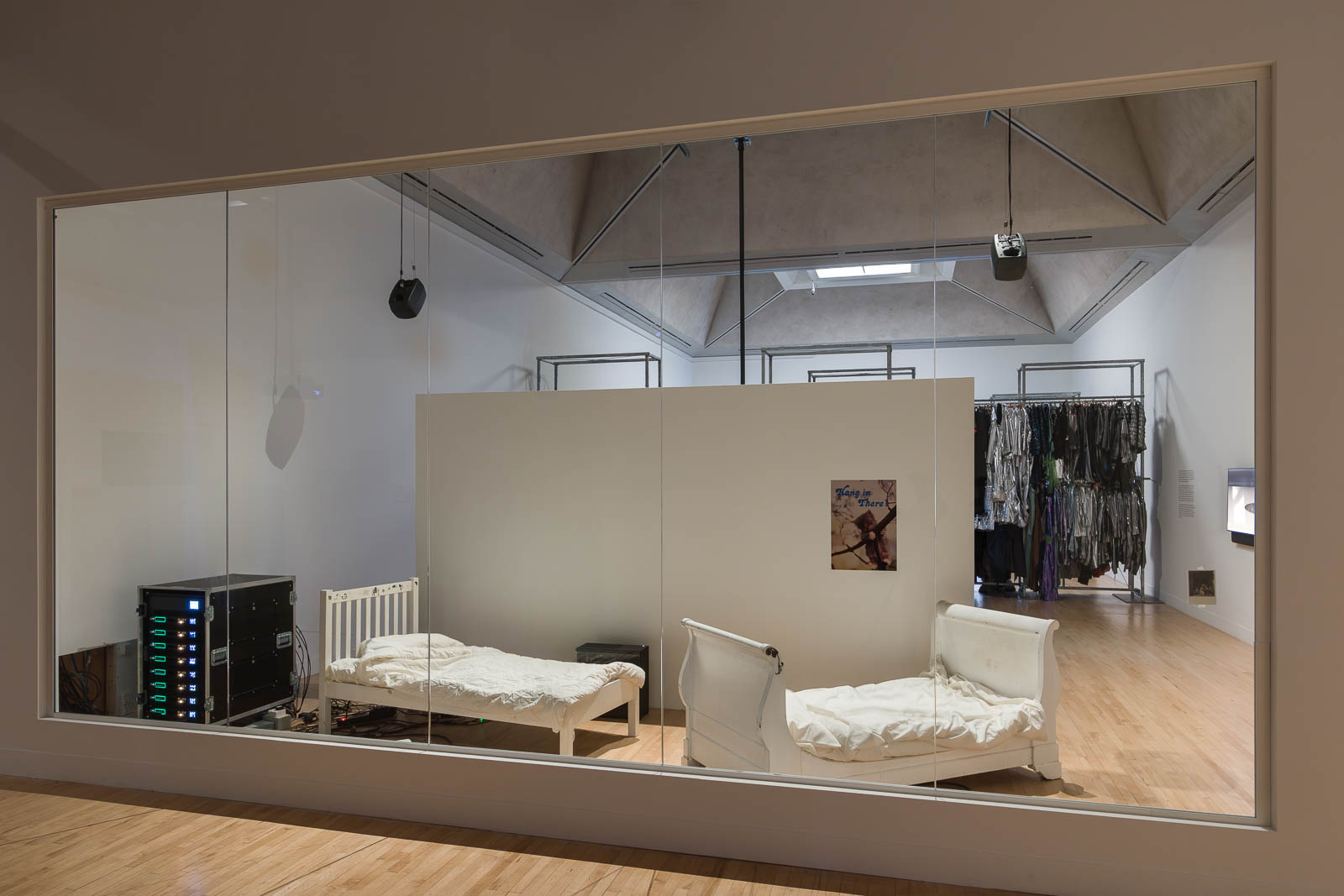
Beds, 2025 Motor, battery, wooden bed frame, cotton sheets The mechanism that undulates inside these two empty beds was designed for the play Sorcerer, which I wrote and directed with the poet Steven Zultanski in 2022. In the play, a single bed stands slightly off-stage as a kind of psychological proxy, its covers writhing unceasingly. We wrote Sorcerer during the Covid-19 pandemic. It's a play about intimacy and the pleasures of being with others and of being alone. The awkwardness of live theatre is present in much of my work. When an actor breaks character during a scene, it's known as 'corpsing'. I want everything I make to corpse.
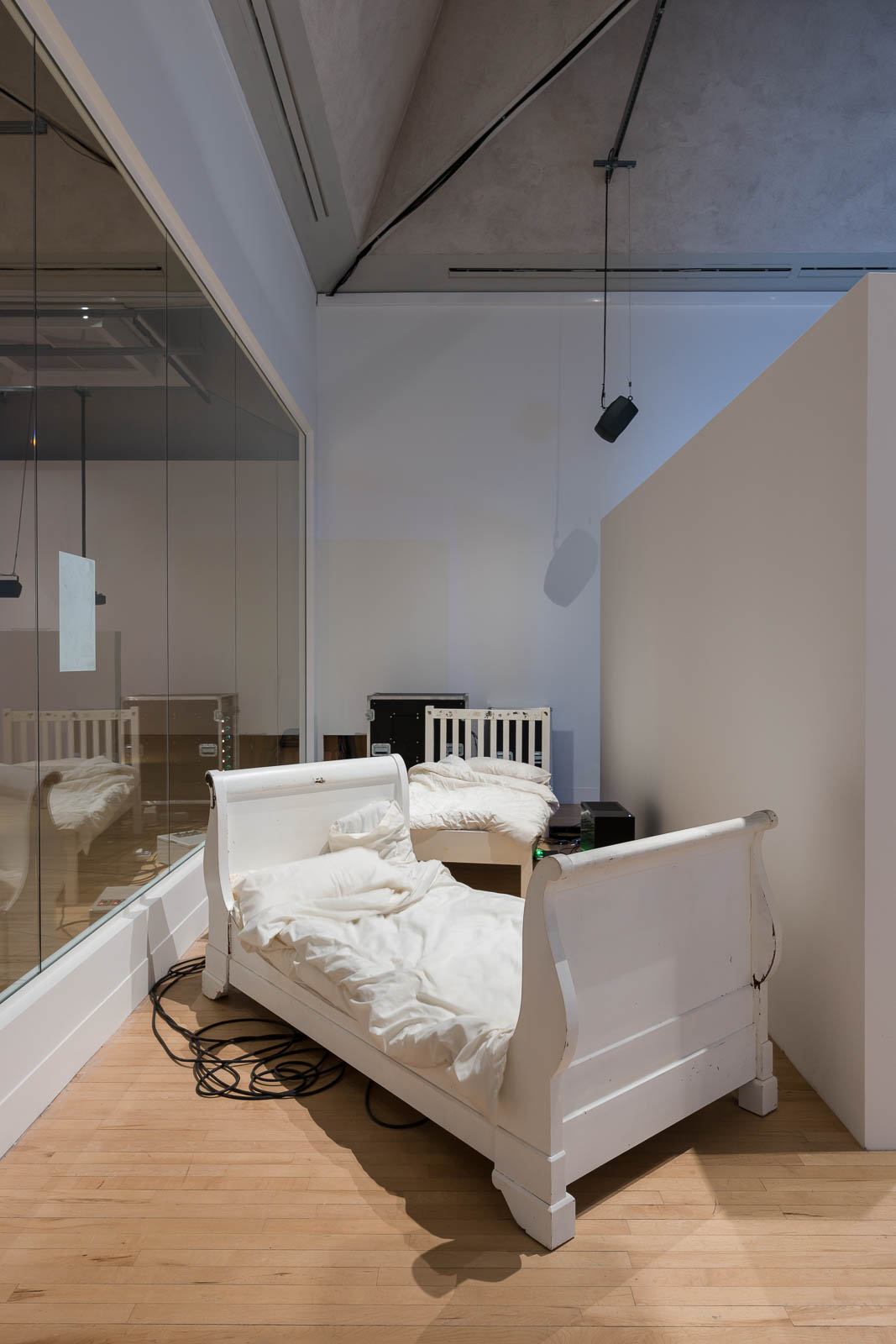
Beds, 2025 Motor, battery, wooden bed frame, cotton sheets The mechanism that undulates inside these two empty beds was designed for the play Sorcerer, which I wrote and directed with the poet Steven Zultanski in 2022. In the play, a single bed stands slightly off-stage as a kind of psychological proxy, its covers writhing unceasingly. We wrote Sorcerer during the Covid-19 pandemic. It's a play about intimacy and the pleasures of being with others and of being alone. The awkwardness of live theatre is present in much of my work. When an actor breaks character during a scene, it's known as 'corpsing'. I want everything I make to corpse.
Refuse.exe is a piece of software that runs across two screens. This is the lower screen, the upper is in a later room of the exhibition. Here, a litany of junk and weather falls onto a stage, accumulating in a great mound of crap. The work is generated live using a modified version of the video game engine Unreal. It's a physics simulation as proposition – a rudimentary video game that plays itself. Importantly, it is not a recording. Each run-through is scripted but fundamentally different.
I think of Refuse.exe as stripped-back theatre. It was originally conceived as such. I wanted to reduce drama to a grim concentrate. Bin juice. A sequence of things would drop down to an empty stage at dramatic intervals, forming a big pile. I got quite far with these plans – talking with theatres about the load-bearing capacity of their stages, how to stop shards of glass flying into the audience, etc. – but my ideas were ultimately too expensive and impractical. Dramatising a simulation felt like a fantastical alternative.
Lists of things are everywhere in the show. Lists are my favourite kind of literature: flat, objective and pragmatic while remaining abstract, personal and withholding. Refuse.exe is a list of waste. It relates to the ordering of material and psychological things as data, an organising principle that can feel both violently crude and deeply satisfying.
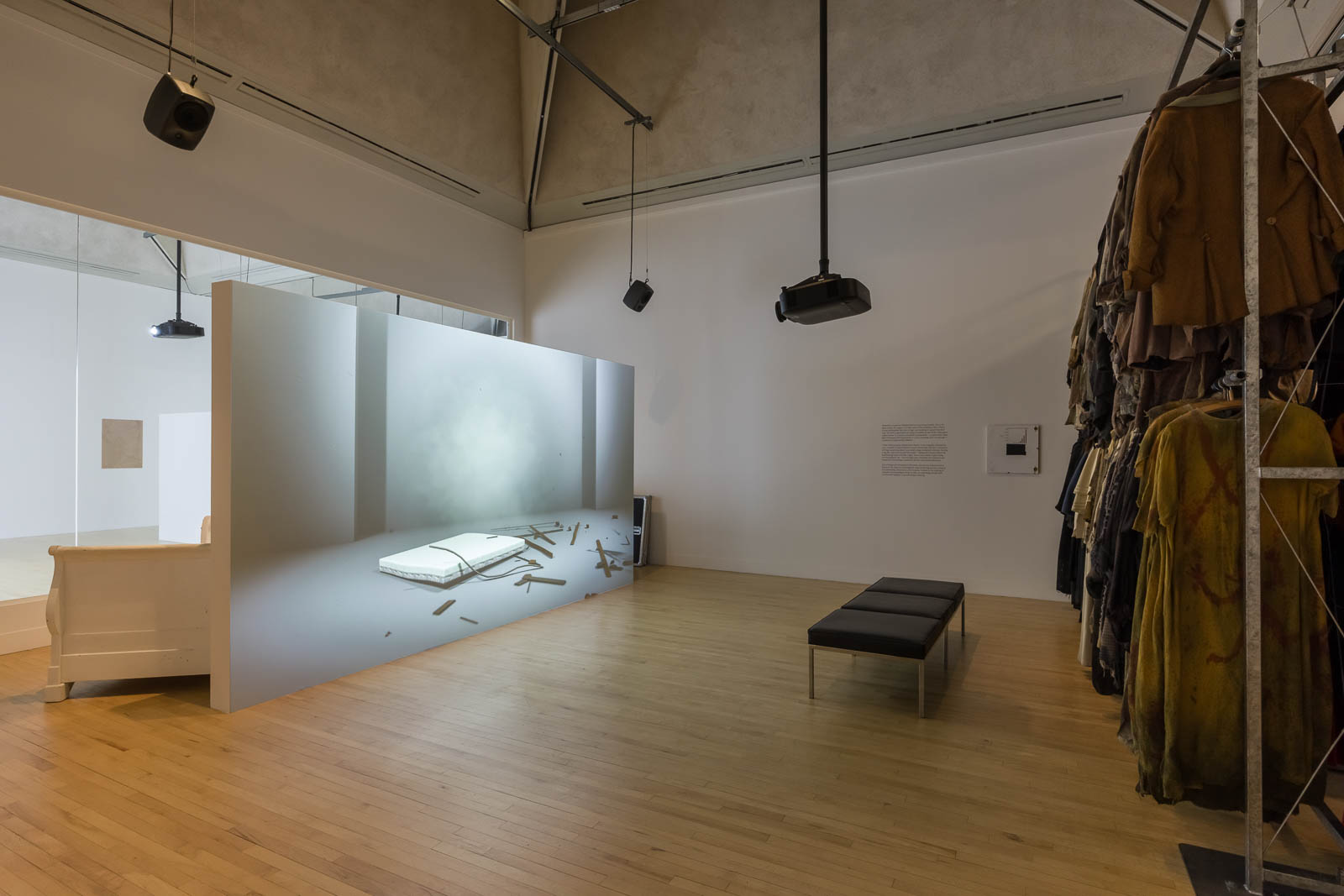
Refuse.exe (Lower screen), 2019 Two-channel realtime 3D simulation authored in a custom version of the Unreal Engine Edition of 8
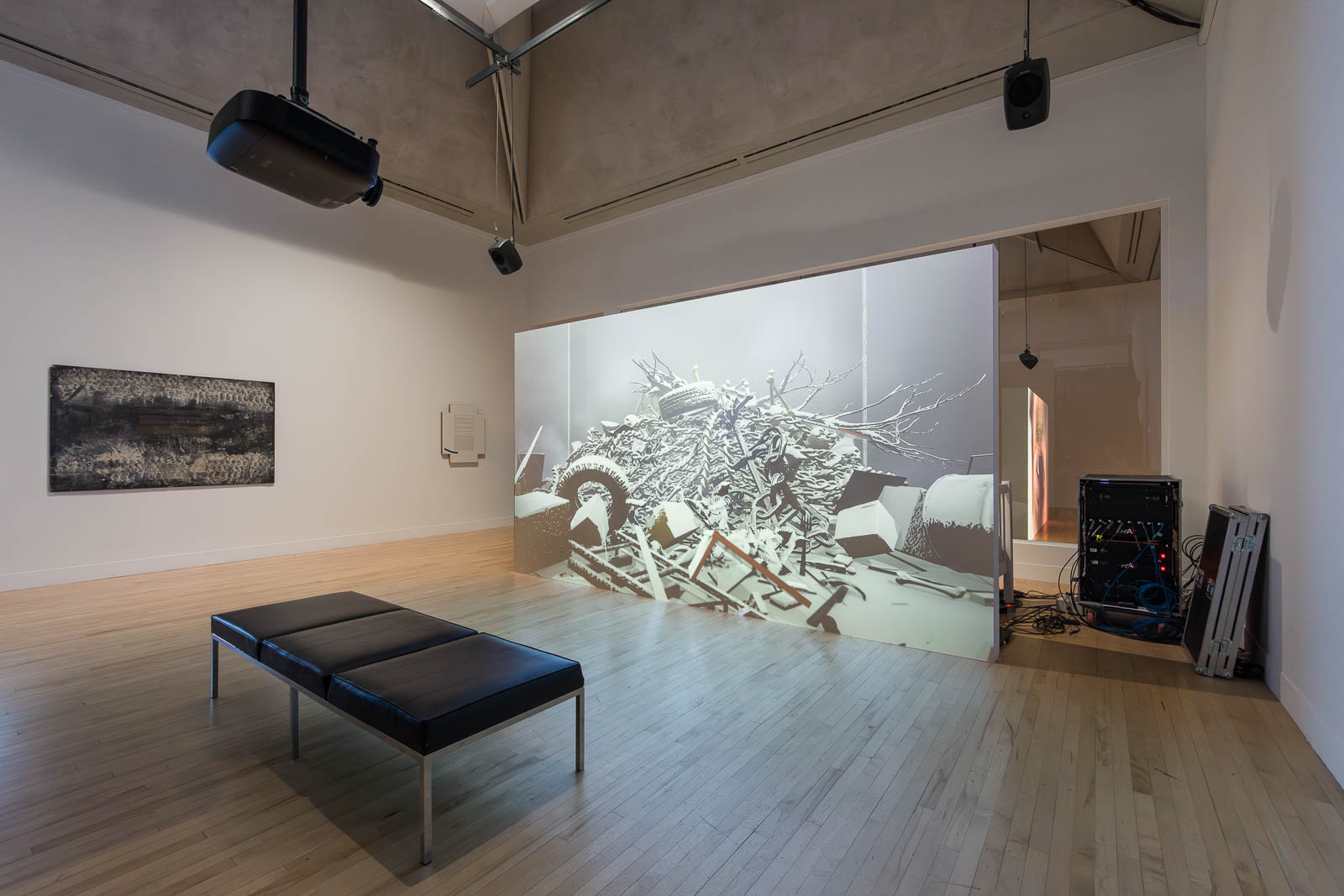
Refuse.exe (Lower screen), 2019 Two-channel realtime 3D simulation authored in a custom version of the Unreal Engine Edition of 8
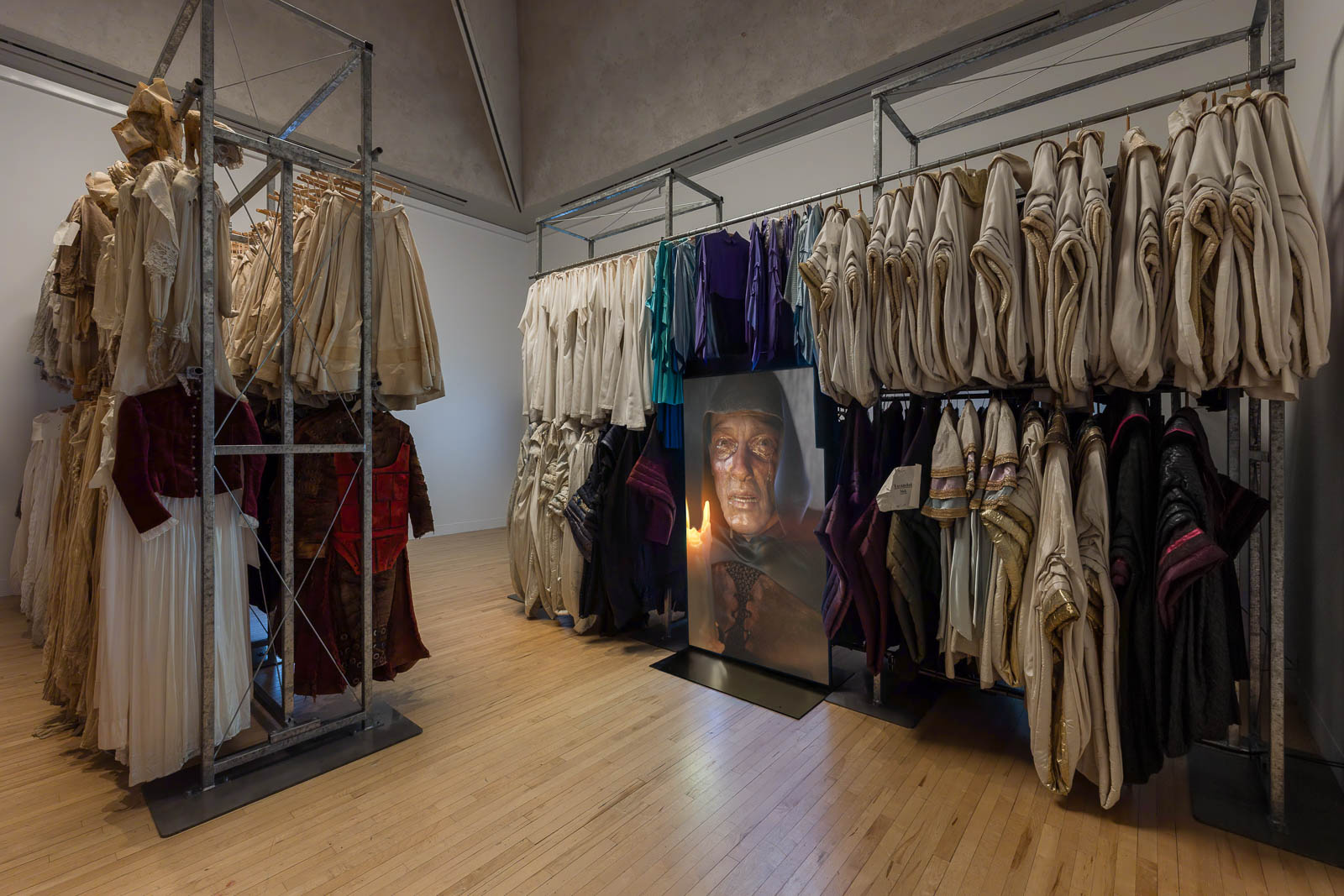
Old Food is a group of looping computer-generated animations among racks of costumes. It stages a pseudo-historic world of peasantry, bucolic landscape and eternal ruin. The characters weep continuously, their lives devoid of dramatic redemption. I had the title Old Food long before I made any of the work. Food seems at such profound odds with the digital. The tears in these videos have the same weird feeling.
I think of these animations and the figures that populate them as things that yearn. They long for the inarticulacies of life – experiences that the technology cannot reproduce. The baby, the boy and the man weep constantly, without cause. They try and fail to speak, gawping imploringly from their screens. They're me. The costume racks stand between in their thronged masses. I got them from the Deutsche Oper, an opera house in Berlin. The costumes are heavy, soiled husks, absent their animating actors. The audience completes the work as the only living bodies in the room.
Old Food is significant because it's almost completely devoid of my voice: there's no speaking or overt lyricism. It marks the beginning of a deliberate impoverishment in my work – the feeling of wanting to speak but not knowing what to say. A universe of foley, sound effects and field recordings blooms in place of speech, a world reported through sound. Eyelids slap and peel, heavy leather creaks and buckles tinkle in caricature. And then the music begins.
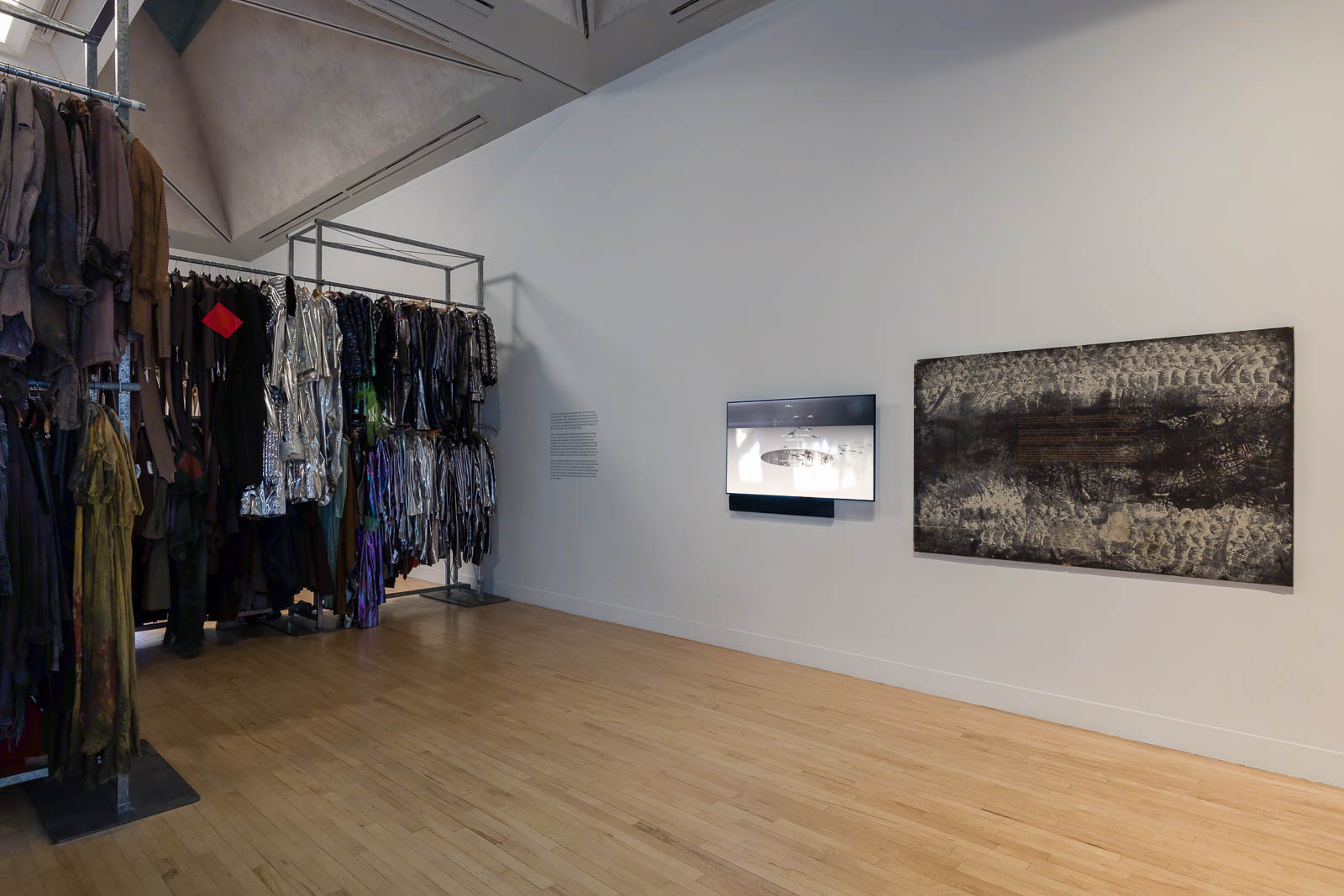
Untitled, 2017 6 laser engraved wood panels These texts are by the anonymous writing project Contemporary Art Writing Daily (CAWD). I don't know who they are, but they're my favourite art critics. For Old Food, I wanted them to write a series of wall texts without having seen the work itself. I described the videos, the thinking, and what I was into via email, then asked them to write whatever they wanted in response. They sent me a backwash of institutional ventriloquism, Wikipedia entries, grotesquery and humour. The texts are laser-burnt into offcut bits of museum trash.
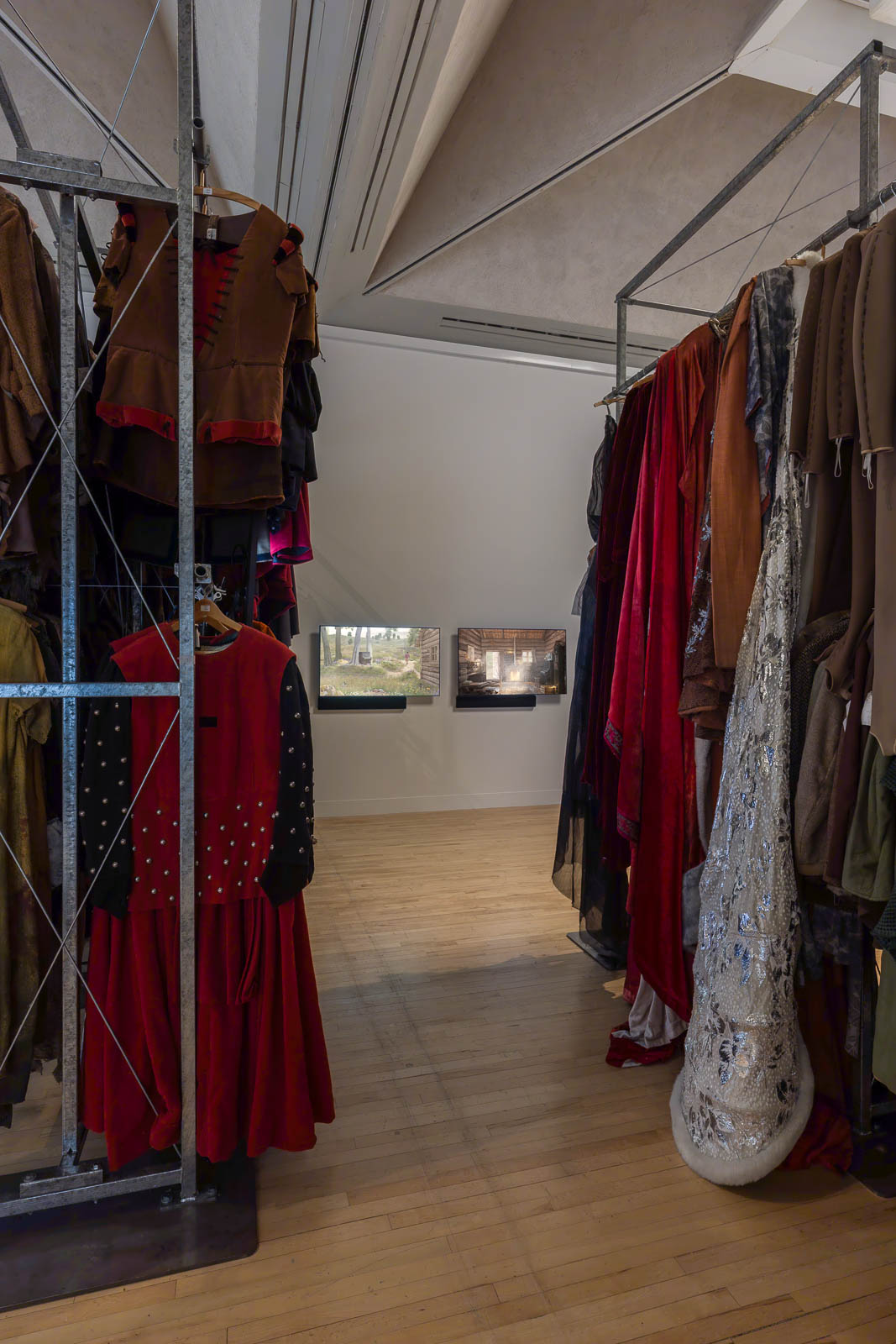
Old Food, 2017
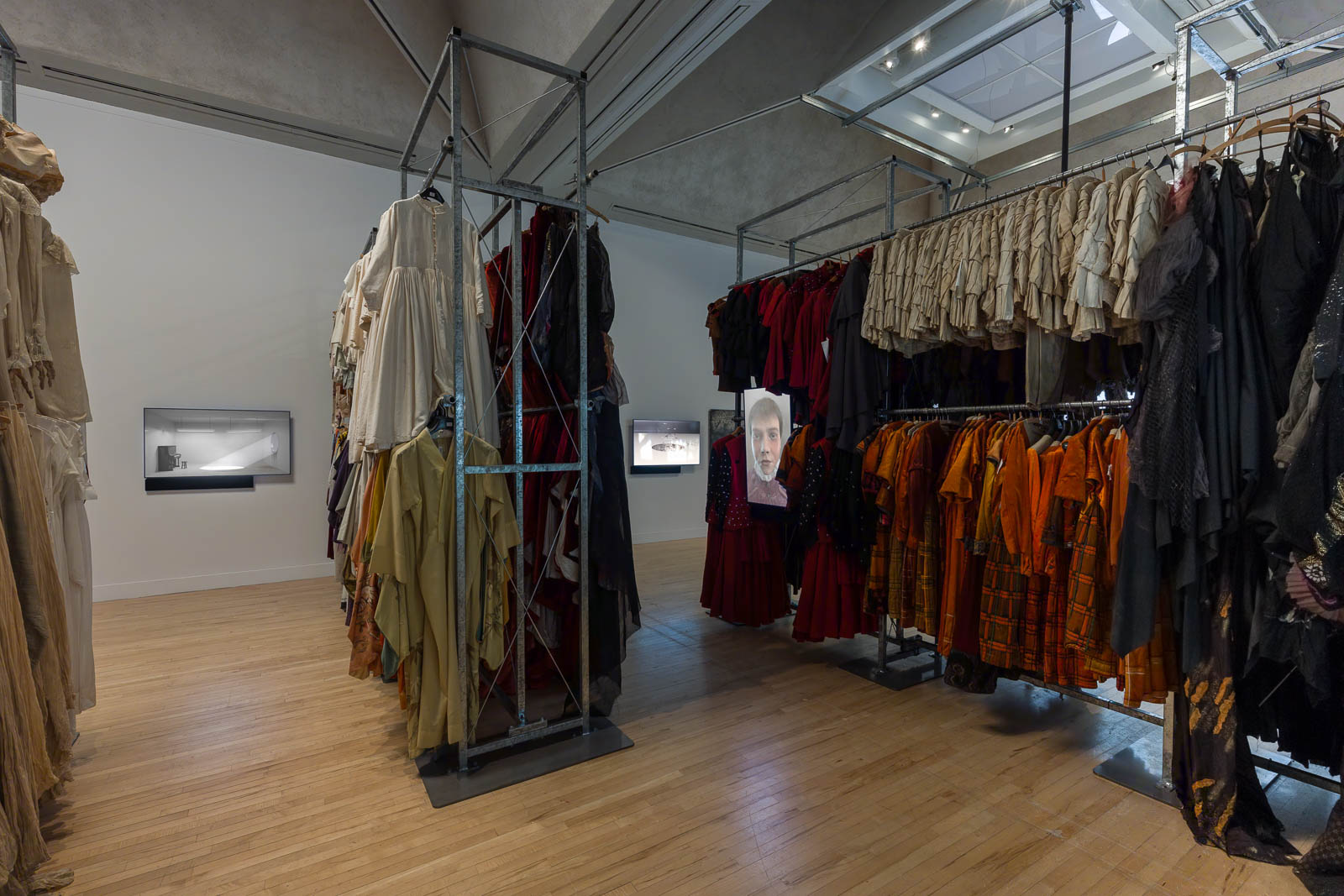
Good Smoke, 2017 Video, high definition, colour and sound Running time: 16 min At the climax of Old Food, 'Extended Circular Music No.2' by the Swiss composer Jürg Frey is performed by the characters – and by extension, me. The loop of piano music rhymes with the loop of the videos: it's purgatorial. It also allegorises the failure of memory, the loss of a sense of an ending. Frey's music is extraordinarily depleted. Depleted not in a pejorative sense, but rather a deliberate impoverishment that essentialises what's left. The sound feels incredibly close to the listener yet resoundingly absent and lonely. This sensation is part of what I'm looking for in my later animations.
Old Food, 2017
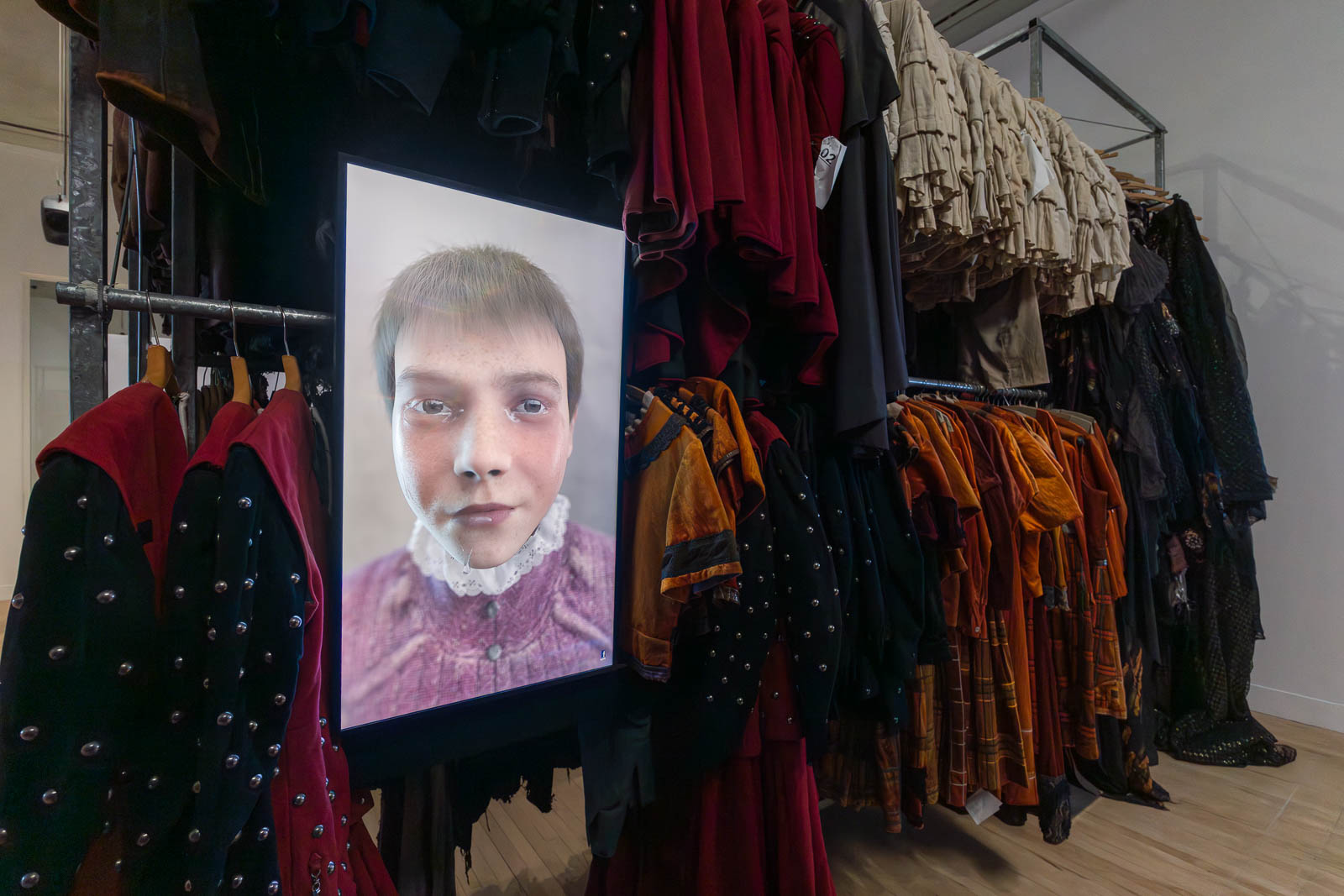
Good Boy, 2017 Video, high definition, colour and sound Running time: 16 min Over the years, I've tested my belief that computer-generated imagery (CGI) always fails to produce a convincing representation of life, regardless of its ever-increasing graphical fidelity. In asking digital technology to conjure things it cannot truly represent or experience it becomes intrinsically pathetic. By compelling computer-generated characters to enact feelings of sadness, I'm trying to compare (but not confuse) CGI's representational impotence with some essential melancholy of human experience.
Pianowork 2 is an animated recording of me playing Jürg Frey's 'Klavierstück 2' at Mimic Productions in Berlin on 22 June 2023. It was a very hot, early summer's day. Mimic created a 'digital double' of me, scanning my head and hands. It was the first time I'd used a computer-generated figure with my own likeness. I played the piece at an upright piano, wearing a sensor-filled Lycra onesie with a head-mounted rig holding an iPhone a short distance from my face.
I tried very hard to do what Frey's score asks. I counted the beats in the vast rests, the 468 instances of the same fourth, the precisely instructed micro-shifts of tempo. I worried about and tried to depress the keys with the correct pianissimo dynamic to follow the previous decayed chord played 40 seconds prior. This agonising pace makes for a terrific mounting of anxiety.
My love of pianos comes from my Mum. She plays beautifully, and her repertoire accounts for much of my sentimental taste. Pianos are machines, too, but my identification with them is empathic. My own roboticness, when alone, is often an excuse for instinctive interactions with technology. Performing 'Klavierstück 2' is a gorgeous crisis, a worrying that operates between my roboticness and my trembling humanity.
I wanted Pianowork 2 to be as stripped back as possible, to refocus on what I felt was important in my use of digital video. However lifelike the fake, there will always be an irrecuperable remainder. This works both ways: I want to rediscover the human in the most inhuman places.
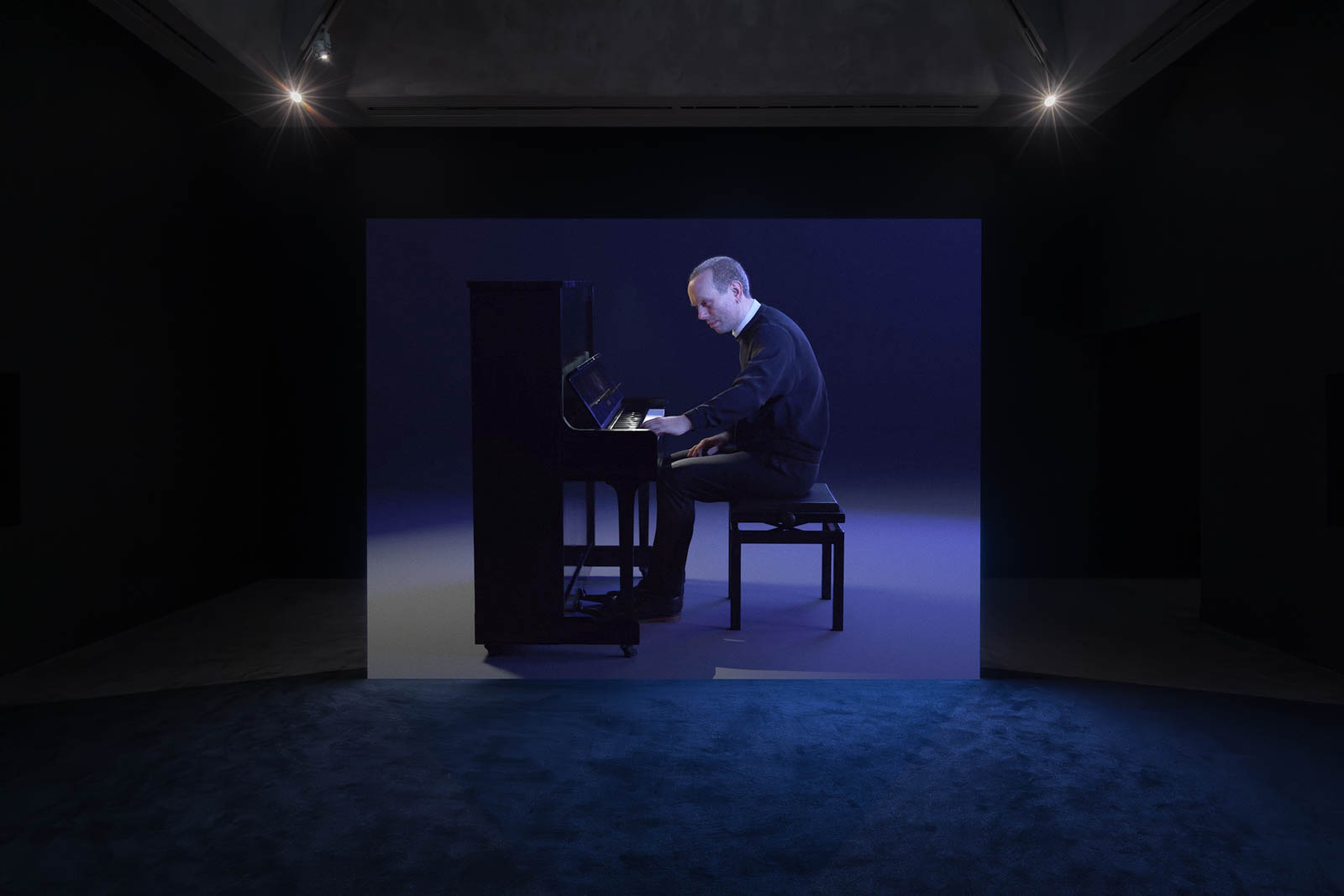
Pianowork 2, 2023 Video projection with sound, loop 15 minutes, 40 seconds Edition of 8 + 2AP
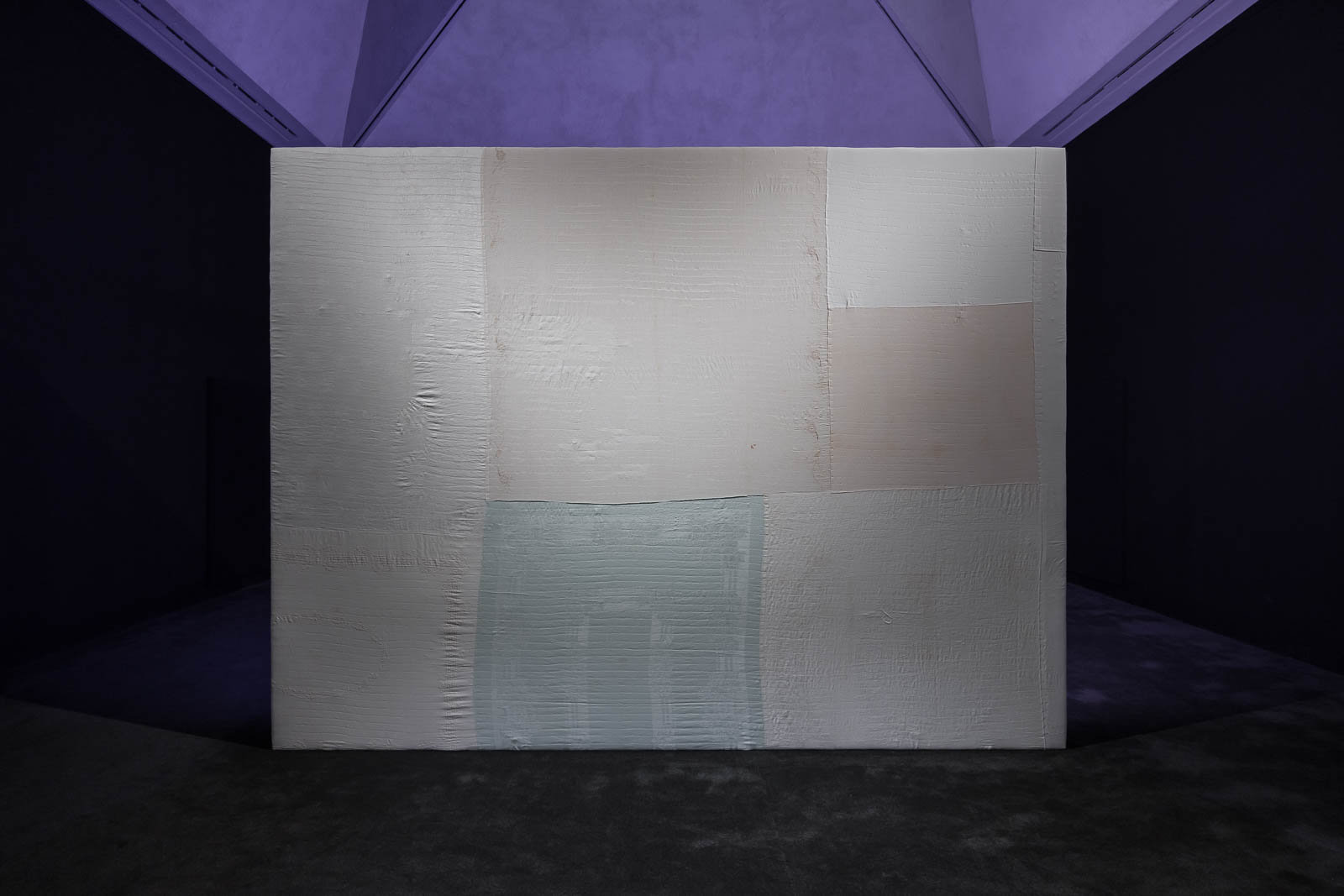
Nearby are two more machine-embroidered lists. They're 'samplers', spaces of literature. I took two historical lists as my starting points. The first was written by the French artist Antonin Artaud around 1943, scrawled in a notebook while he was interred in a psychiatric hospital in Rodez. The second is by the Japanese author Sei Shonagon, a list of squalid things from around 1000 CE. I extended both lists using GPT 3, the artificial intelligence language model. This was a relatively early version of the AI – one that felt feral, unpredictable, and slightly frightening. The entries written by GPT 3 are by turns hilarious, impossible and mind-bogglingly violent. Embroidered, the lists become almost illegible, but I like to think their effects still filter through, like enchantments. My full lists are available to read in the exhibition catalogue, in the reading area outside of the show.
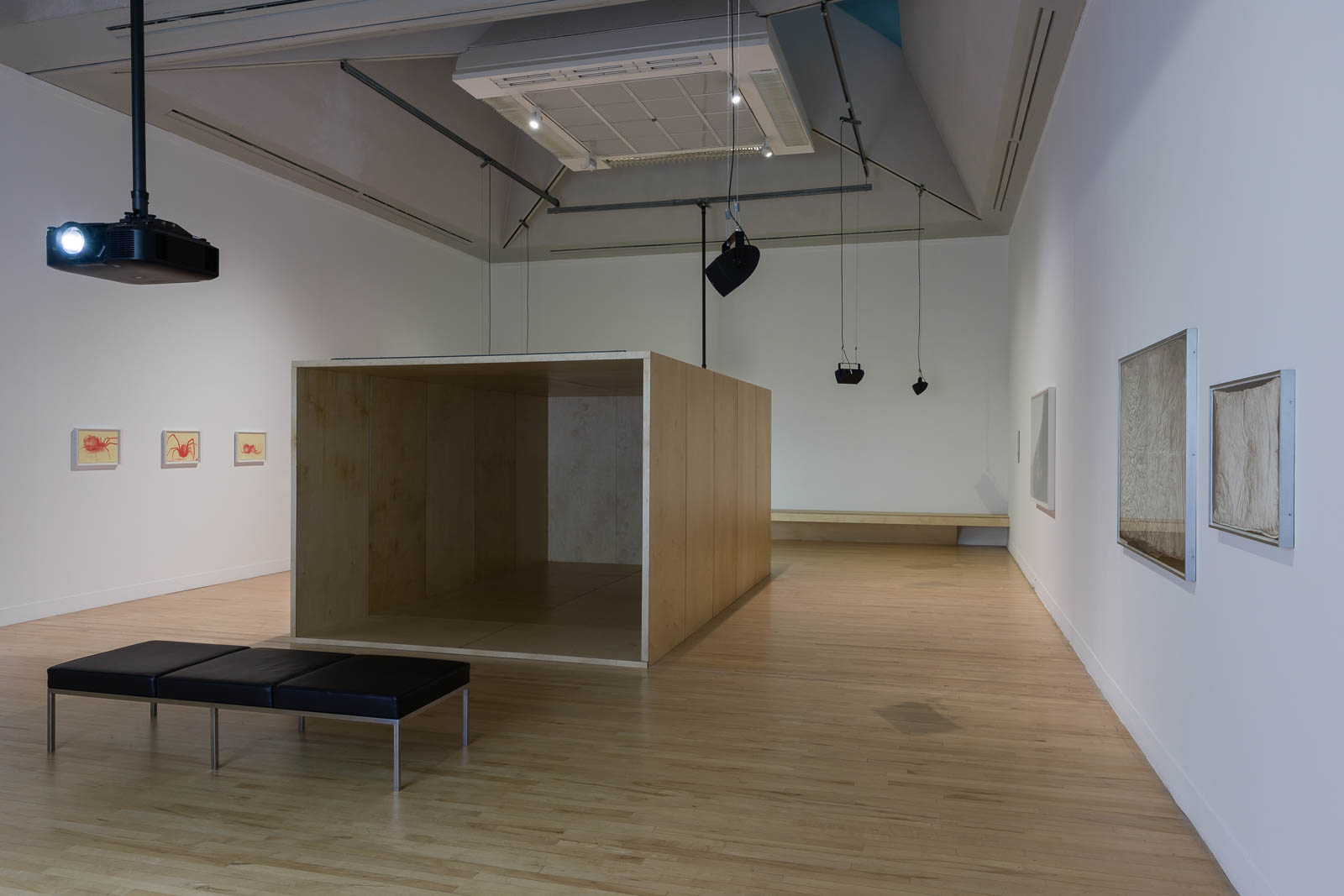
(Right) Untitled, 2020 Ink, gouache and graphite on paperboard These paintings of mattresses and pillows came from a desire to make work that suspended contradictions. As subjects, they're like the costumes from Old Food: upholstered with emptiness. I painted them from photos of my bed, my pillow – straight after getting up off the real things. They struck me as illegible indexes, heavy with dead skin, mite husks and petrified droppings, as well as the bodies that are no longer there. Making these paintings accrues time. On top of the dead skin, dreams and sweat is brushwork. I do love spending a long time on barely anything.
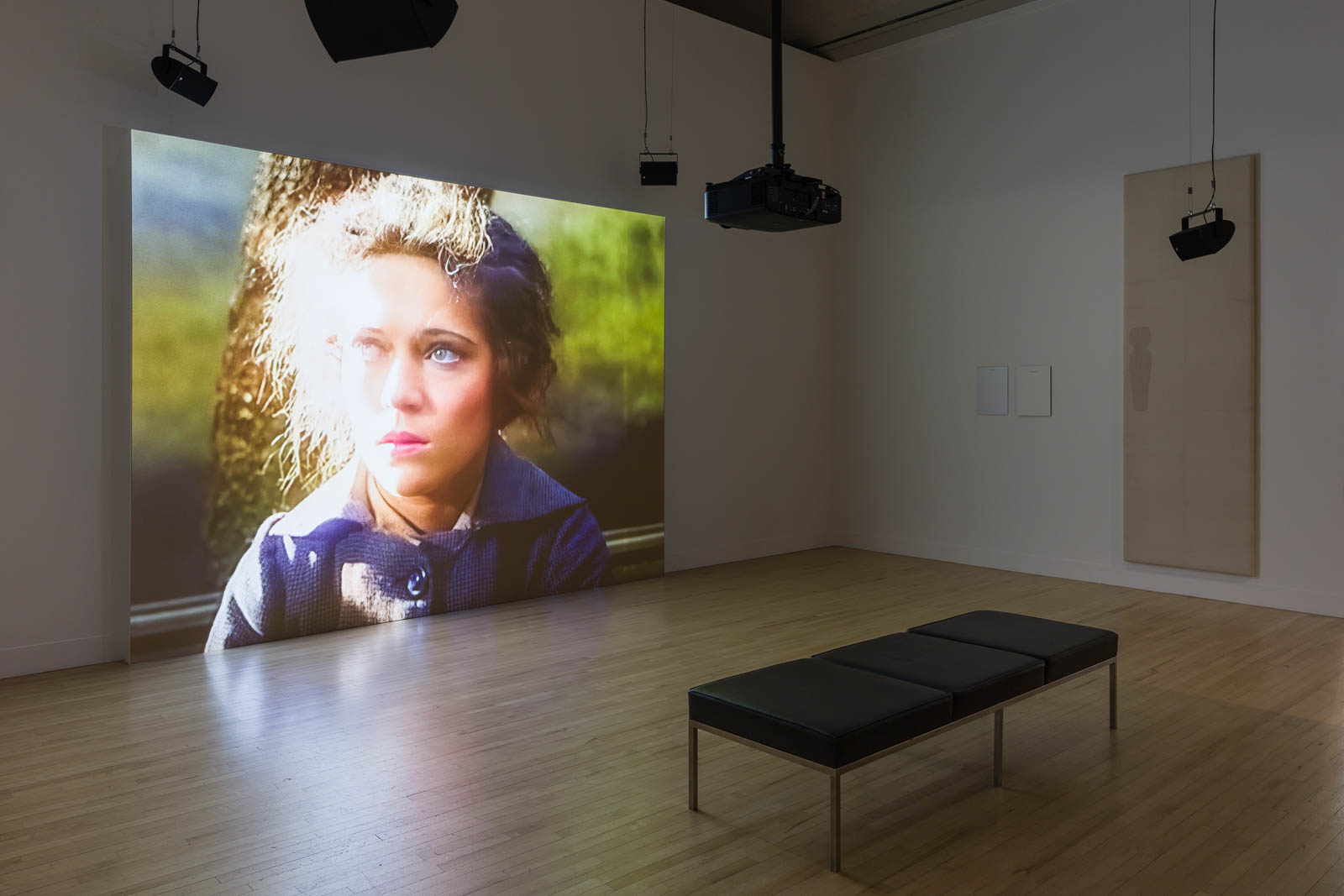
(Left) Voilà la vérité, 2022 4K Video loop (colour, sound) 3 mins 49 secs (looped) Edition of 8 + 2AP Voilà la vérité is a short video that reworks a single sequence from the 1926 silent film Ménilmontant, directed by Dimitri Kirsanoff. It was digitised from a knackered, toned print lent to me by an archive. I've been obsessed with this scene for years – its unaffectedness, the perfect combination of acting and the impossibly real. I cleaned, colourised, upscaled, smoothed, frame-interpolated, focus-pulled, and re-rendered the footage using a raft of artificial intelligence-employing software. I feel like the resulting video is haunted. It's a short essay on the history of the moving image as illusion. The title, Voilà la vérité (This is the truth), is the only discernible text in the film: a fragment of a headline on the newspaper that wraps the food. The foley artist David Kamp performed and recorded a new soundtrack of naturalistic sound – along with less naturalistic elements from me. Two voice actors, Rivka Rothstein and Héctor Miguel Santana, provide the screen characters with new voices. They don't speak but do sob and sigh and eat. Of course it's sacrilegious, this forensic, compensatory, fake restoration. It's a dupe, even if the dupe is a sincere attempt at reanimation. (Right) Contemporary Art Writing Daily Information Panels 11 laser engraved acrylic sheets I asked CAWD to write texts to accompany The worm, as with Old Food. They were written as a response to my emailed aspirations for the work, way before the video existed and took on its final tone. The texts speak about realism, music, Preservaline and Zoom calls. These were etched into sanitary white plastic. Language is an essential part of my work. Institutional texts can sometimes feel grimly pragmatic, treating artworks as things to be explained away. CAWD were a terrific bulwark. They helped make the works more obscure, richer, and messier.
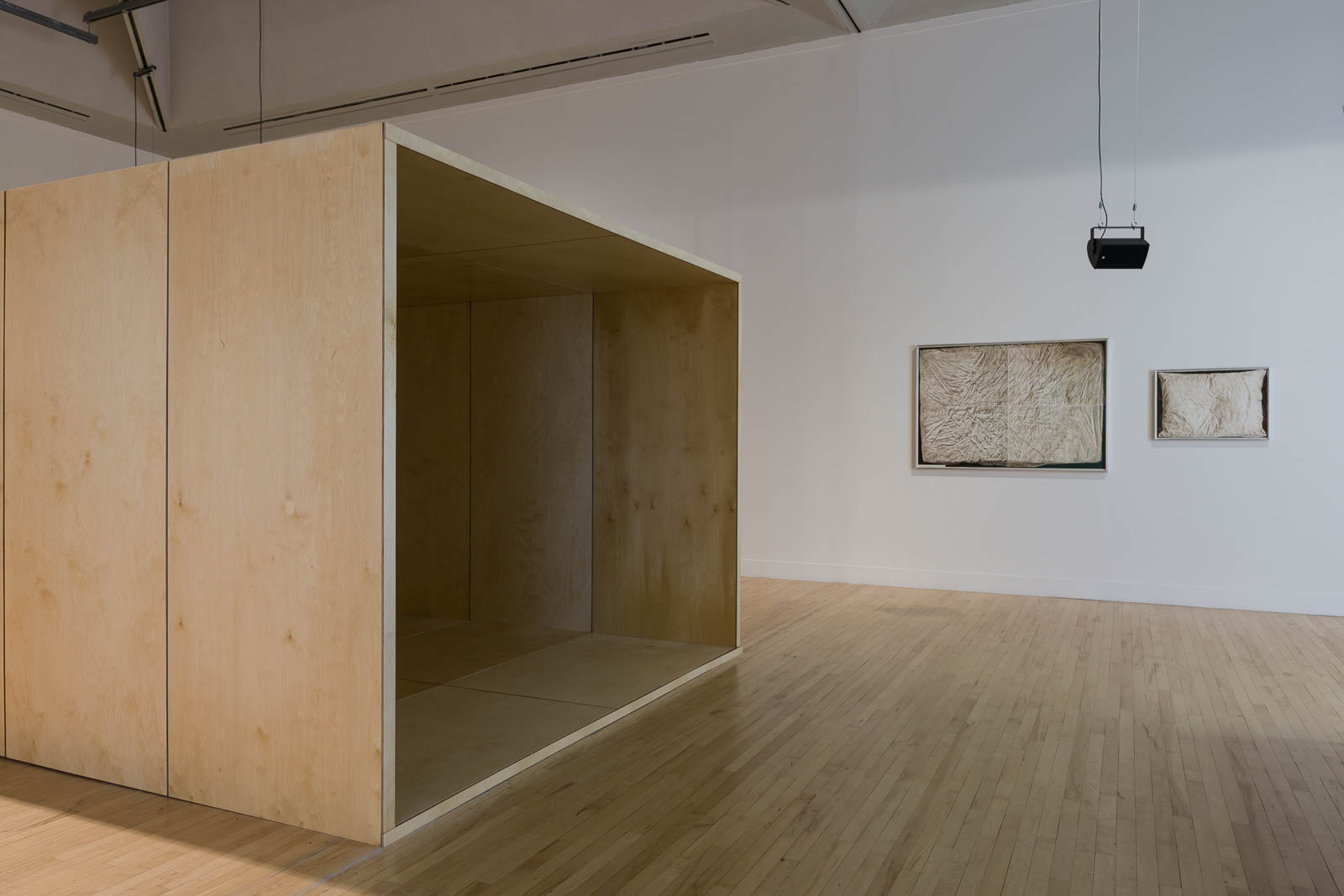
(Right) Untitled, 2020 Ink, gouache and graphite on paperboard These paintings of mattresses and pillows came from a desire to make work that suspended contradictions. As subjects, they're like the costumes from Old Food: upholstered with emptiness. I painted them from photos of my bed, my pillow – straight after getting up off the real things. They struck me as illegible indexes, heavy with dead skin, mite husks and petrified droppings, as well as the bodies that are no longer there. Making these paintings accrues time. On top of the dead skin, dreams and sweat is brushwork. I do love spending a long time on barely anything.
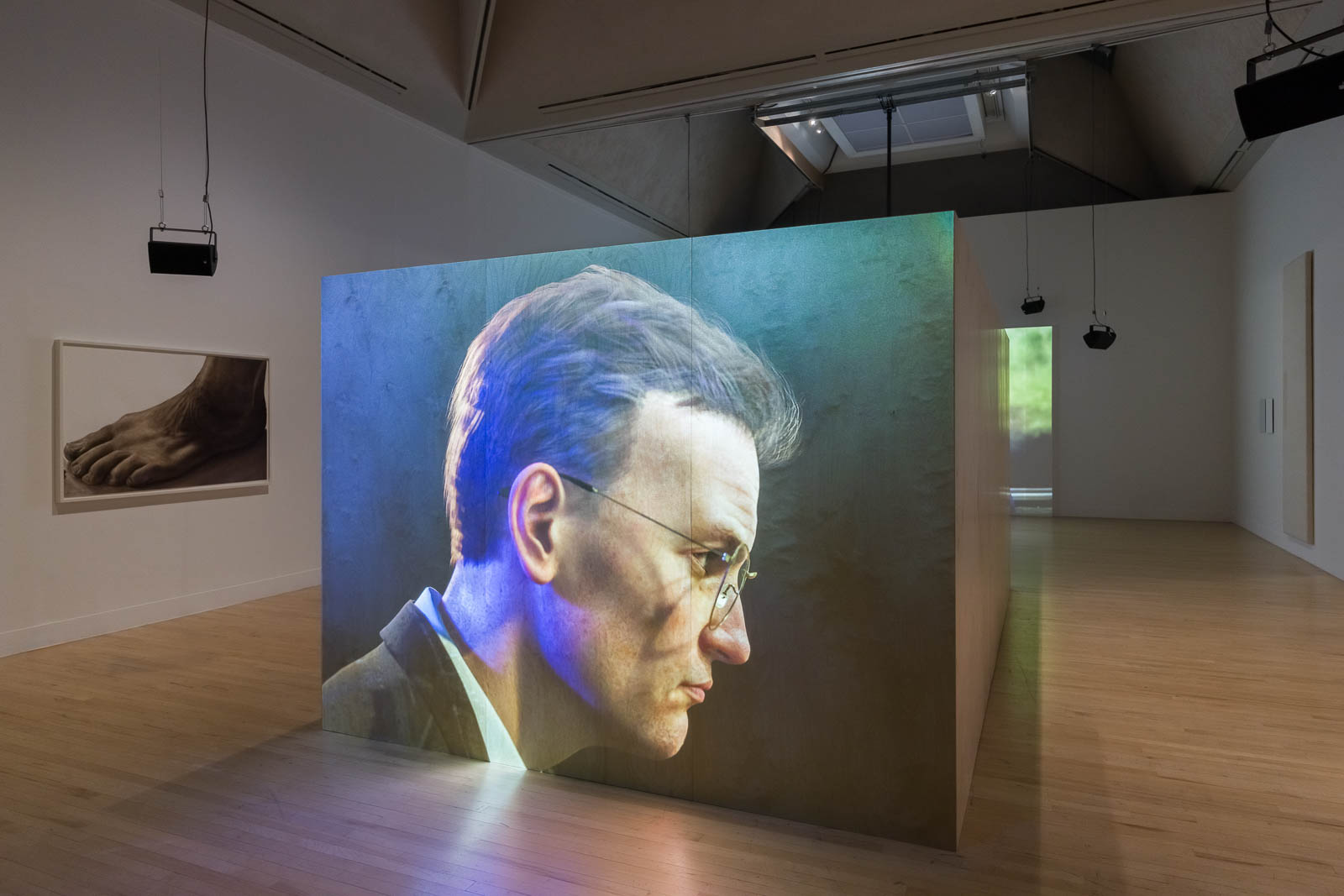
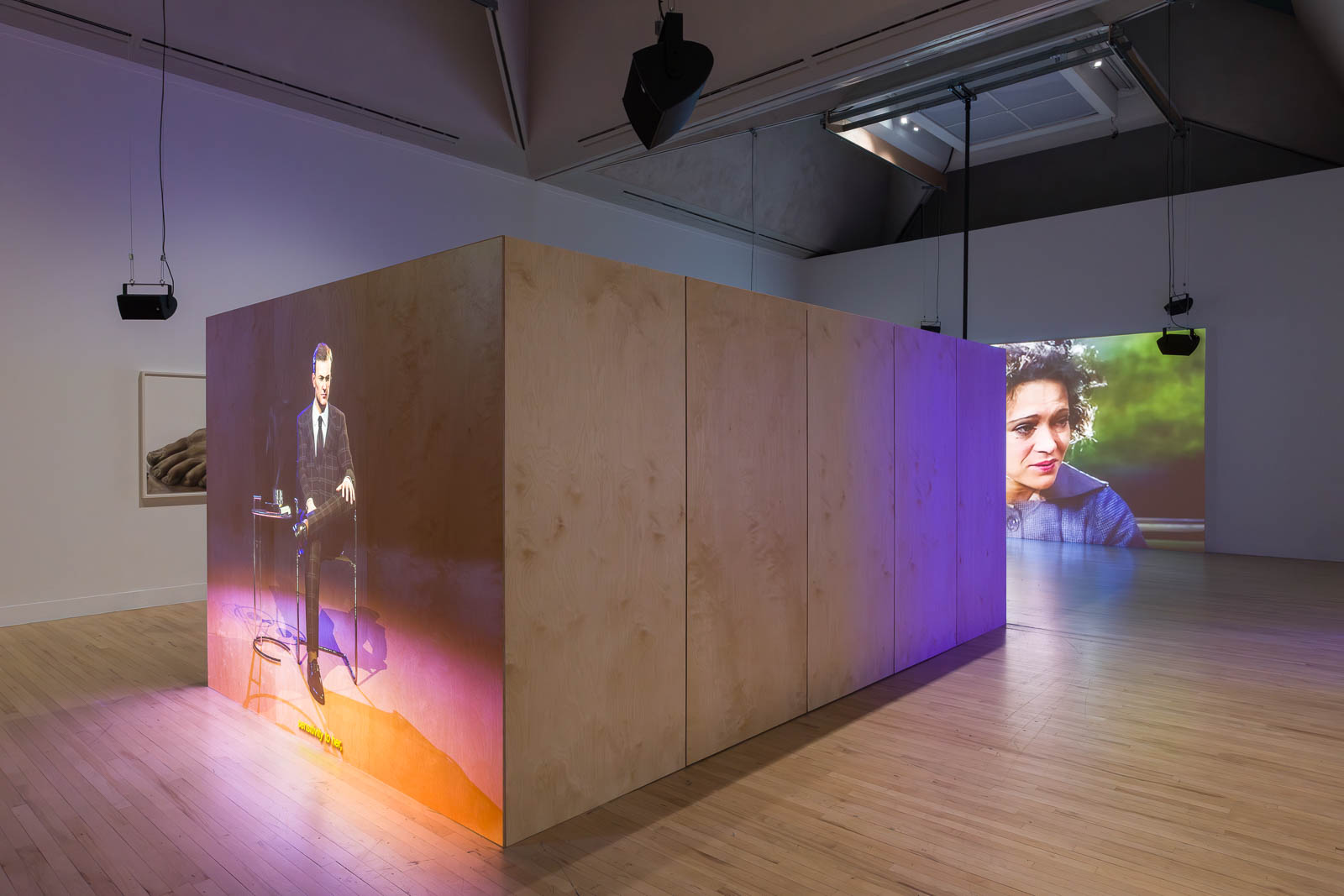
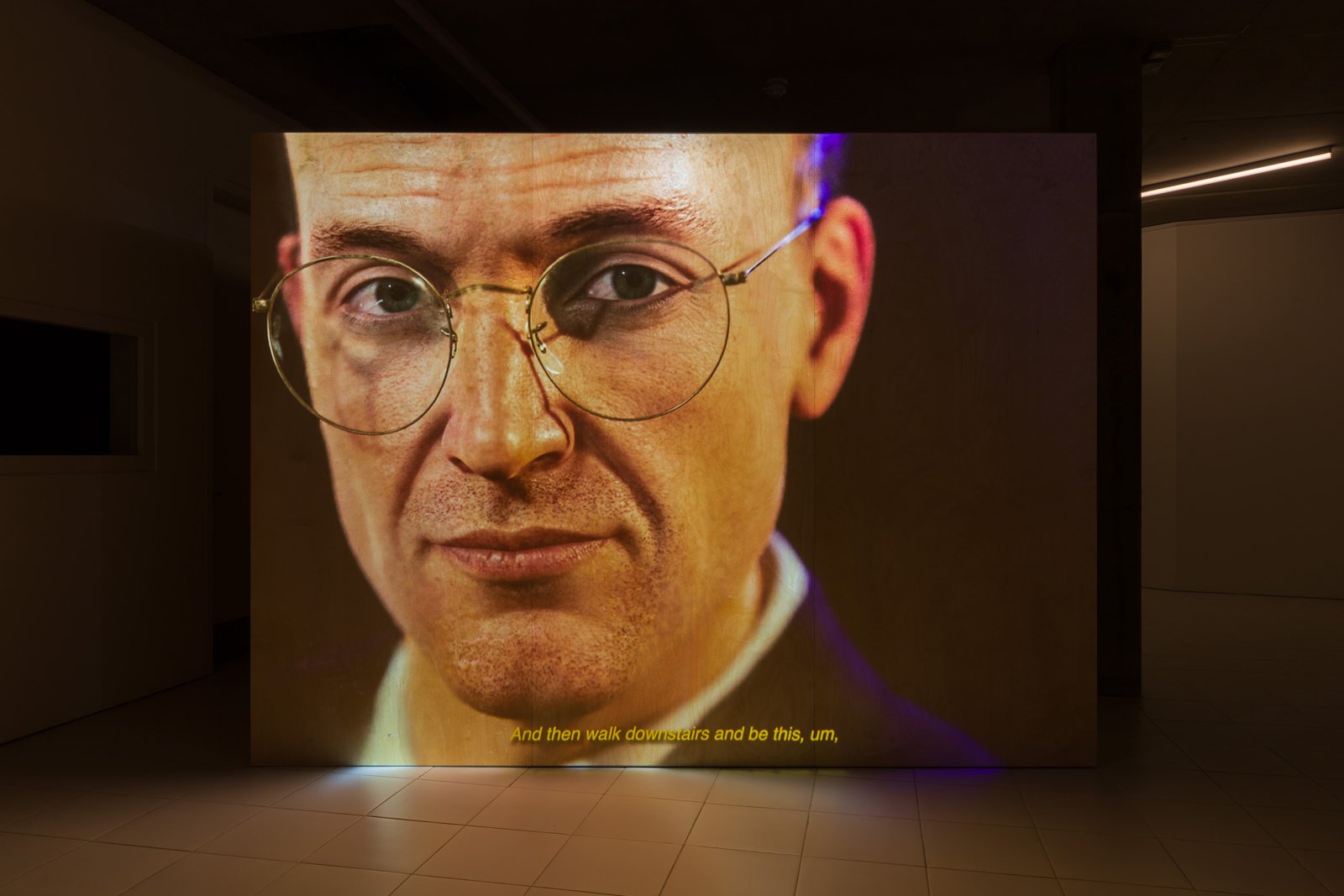
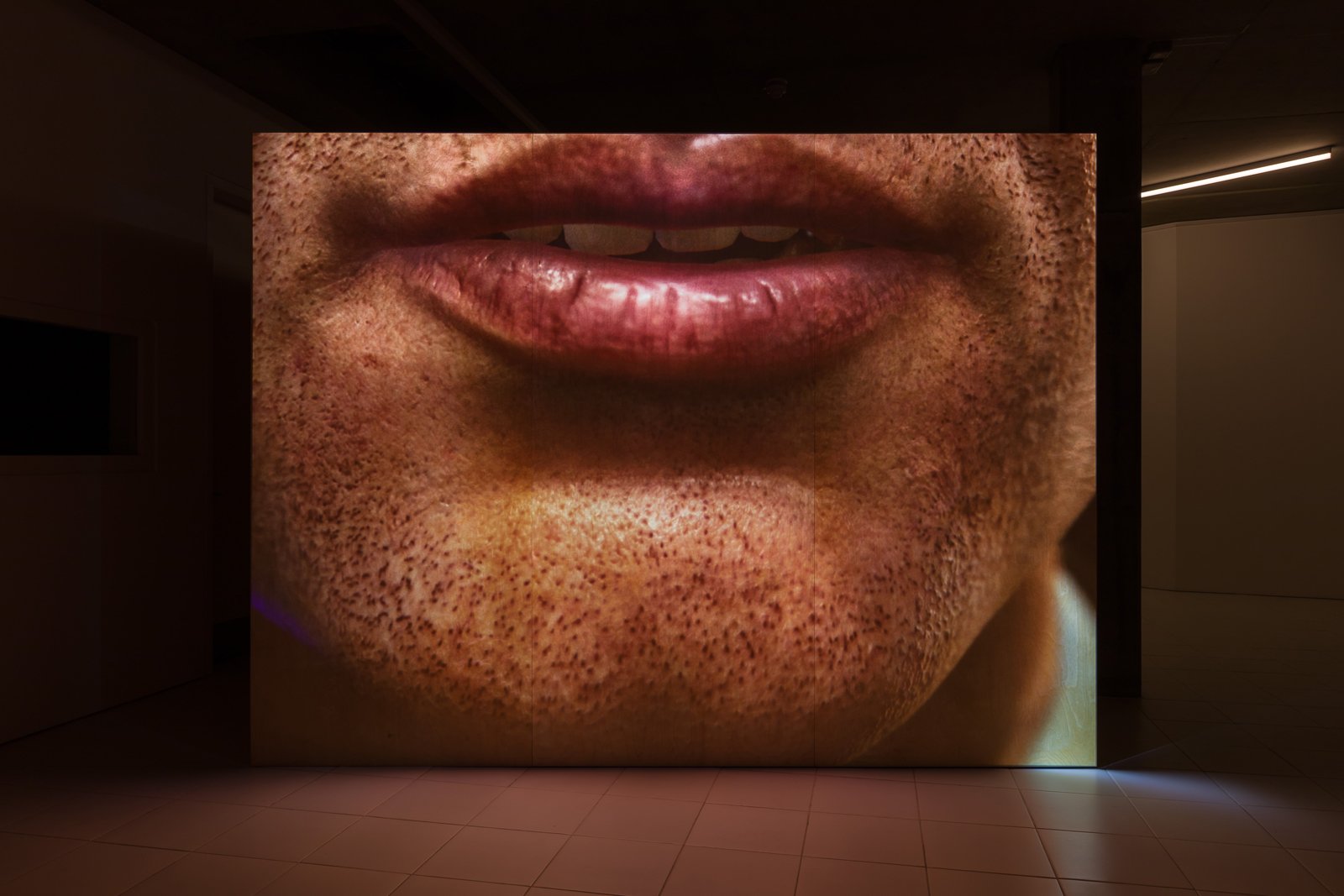
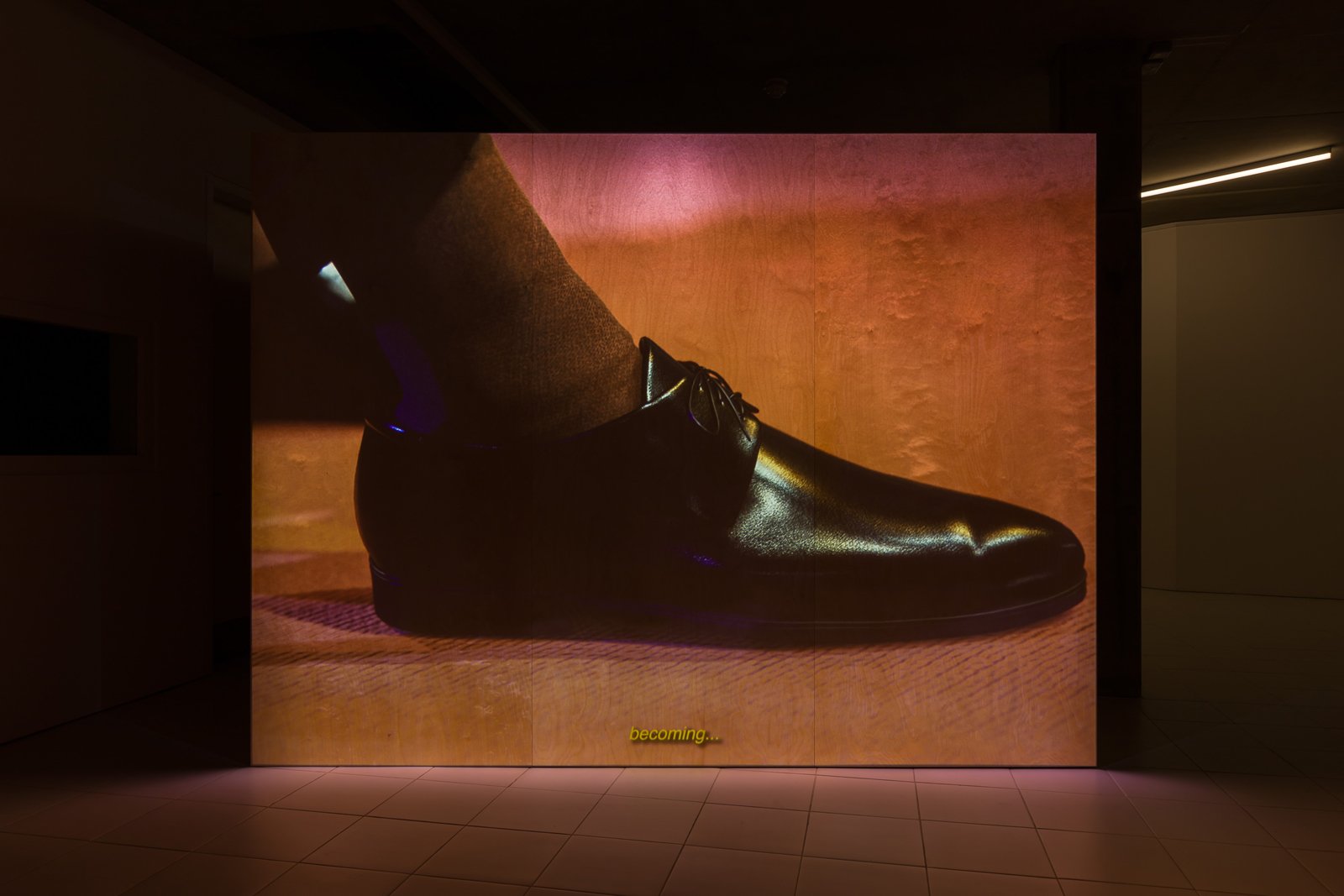
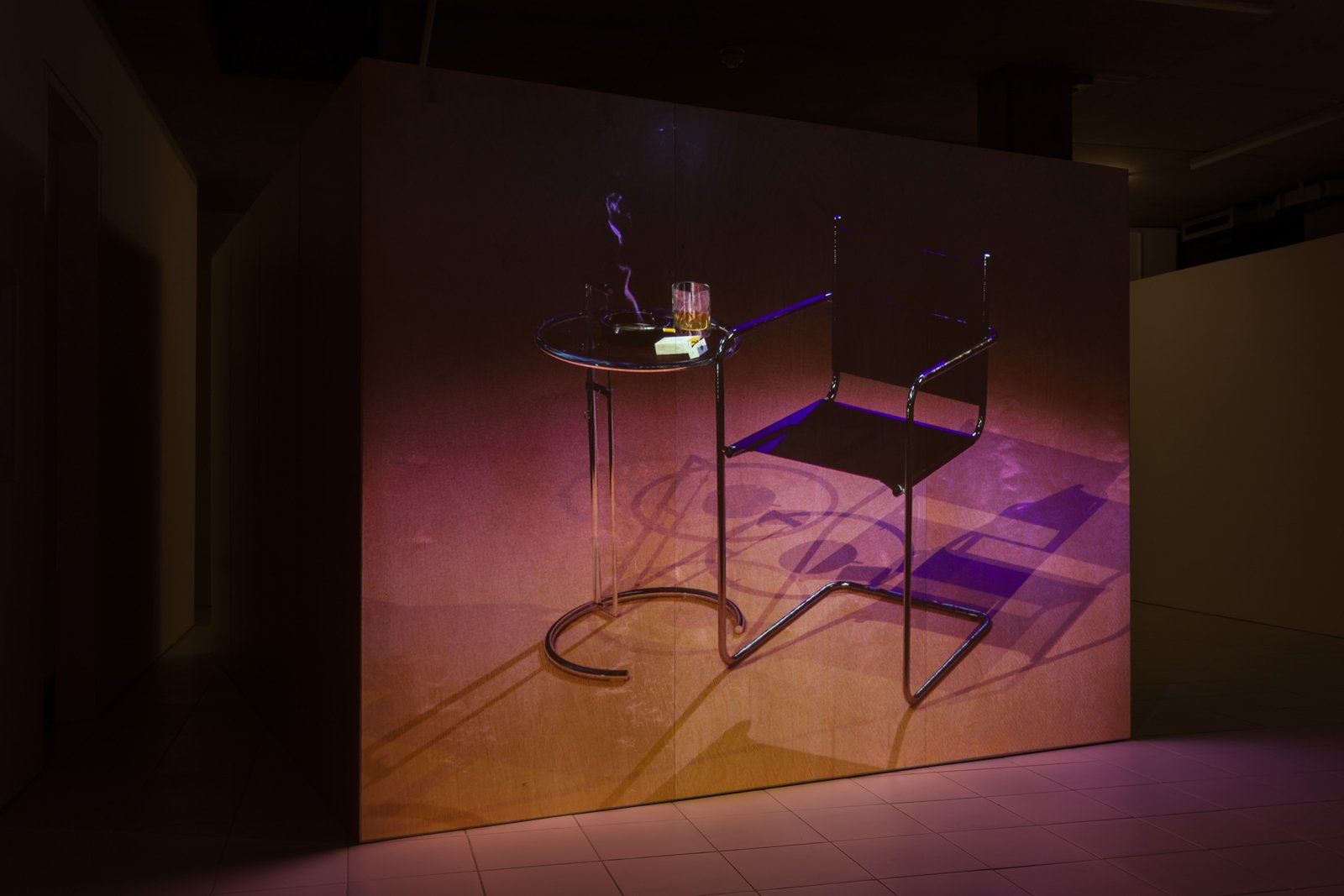
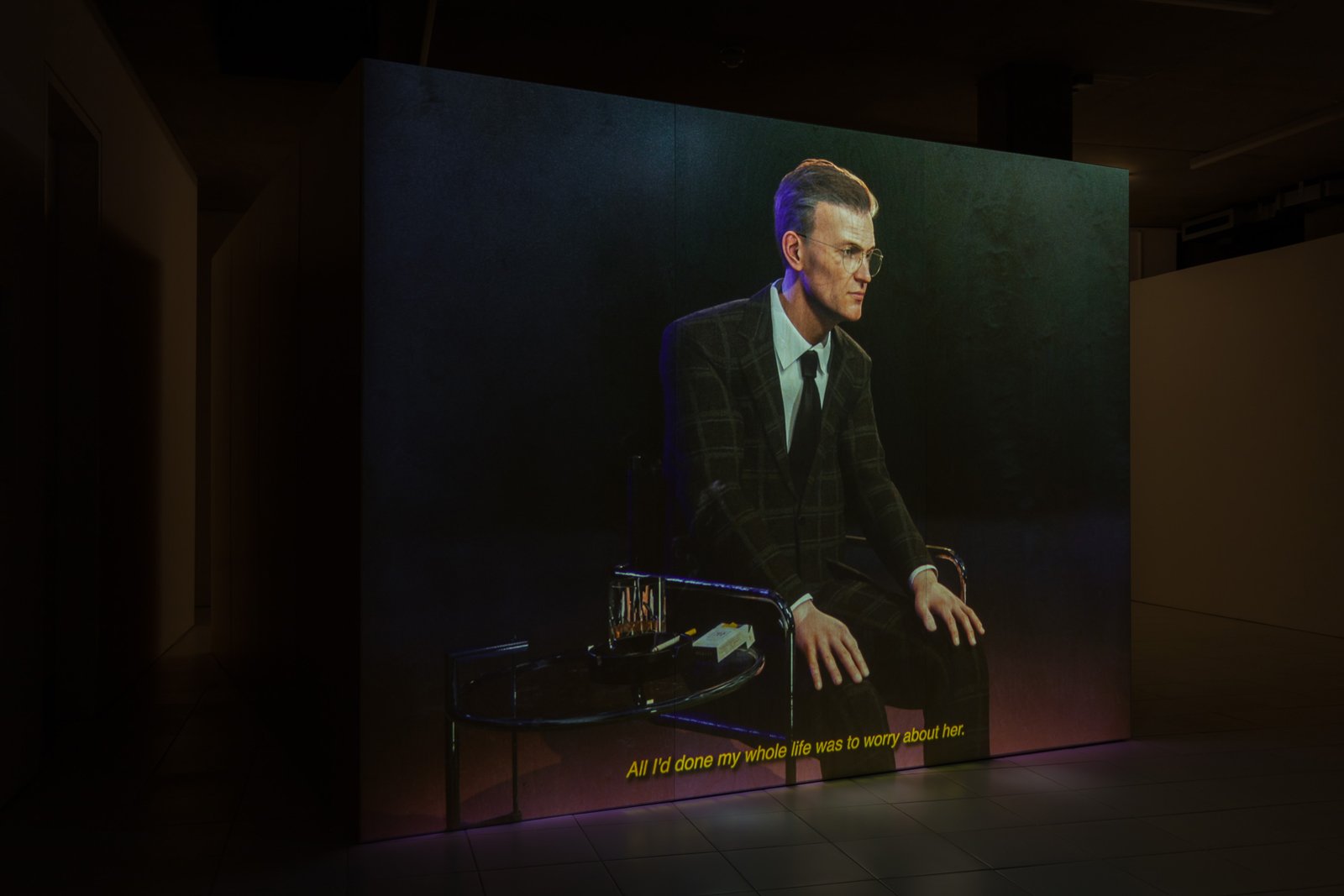
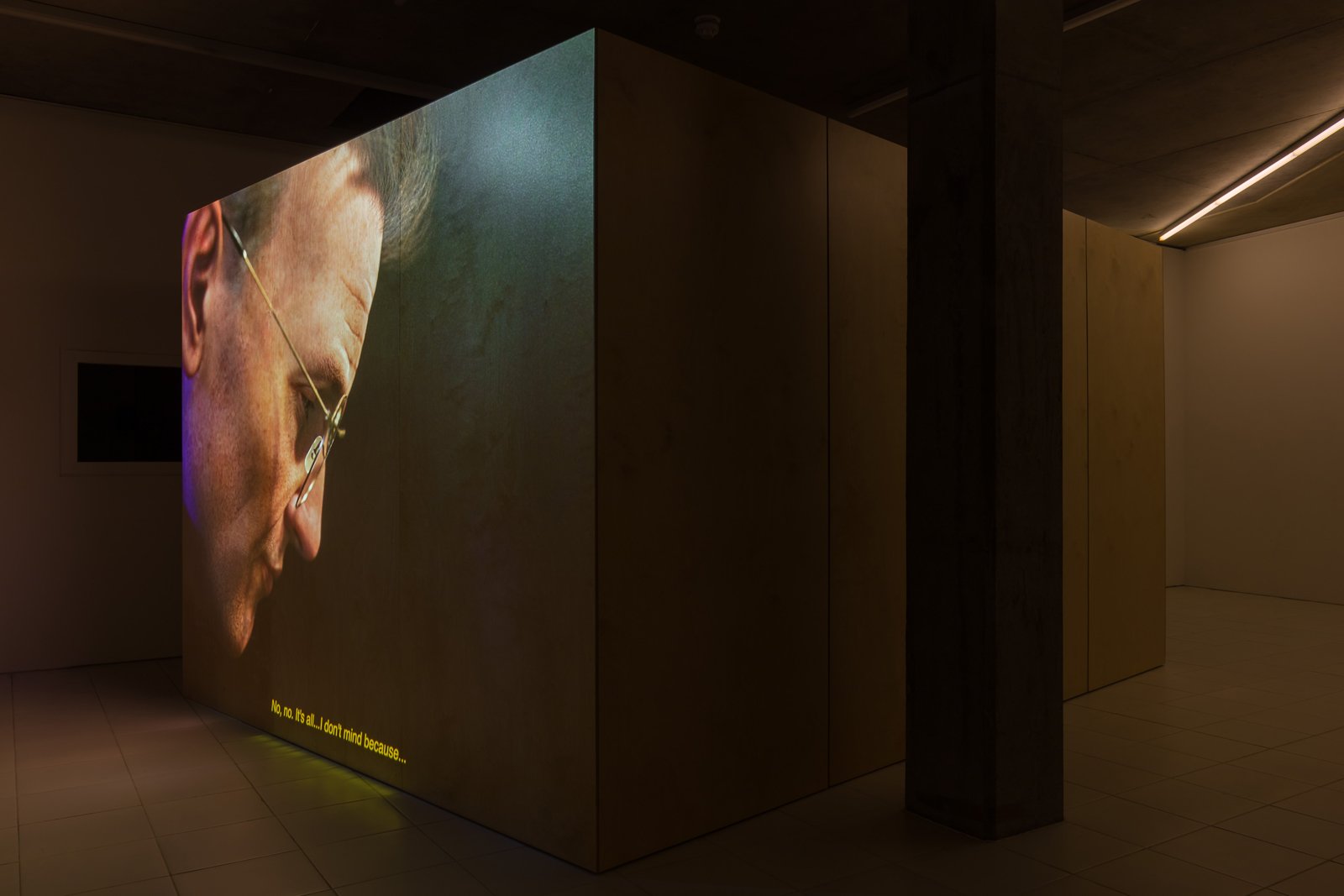
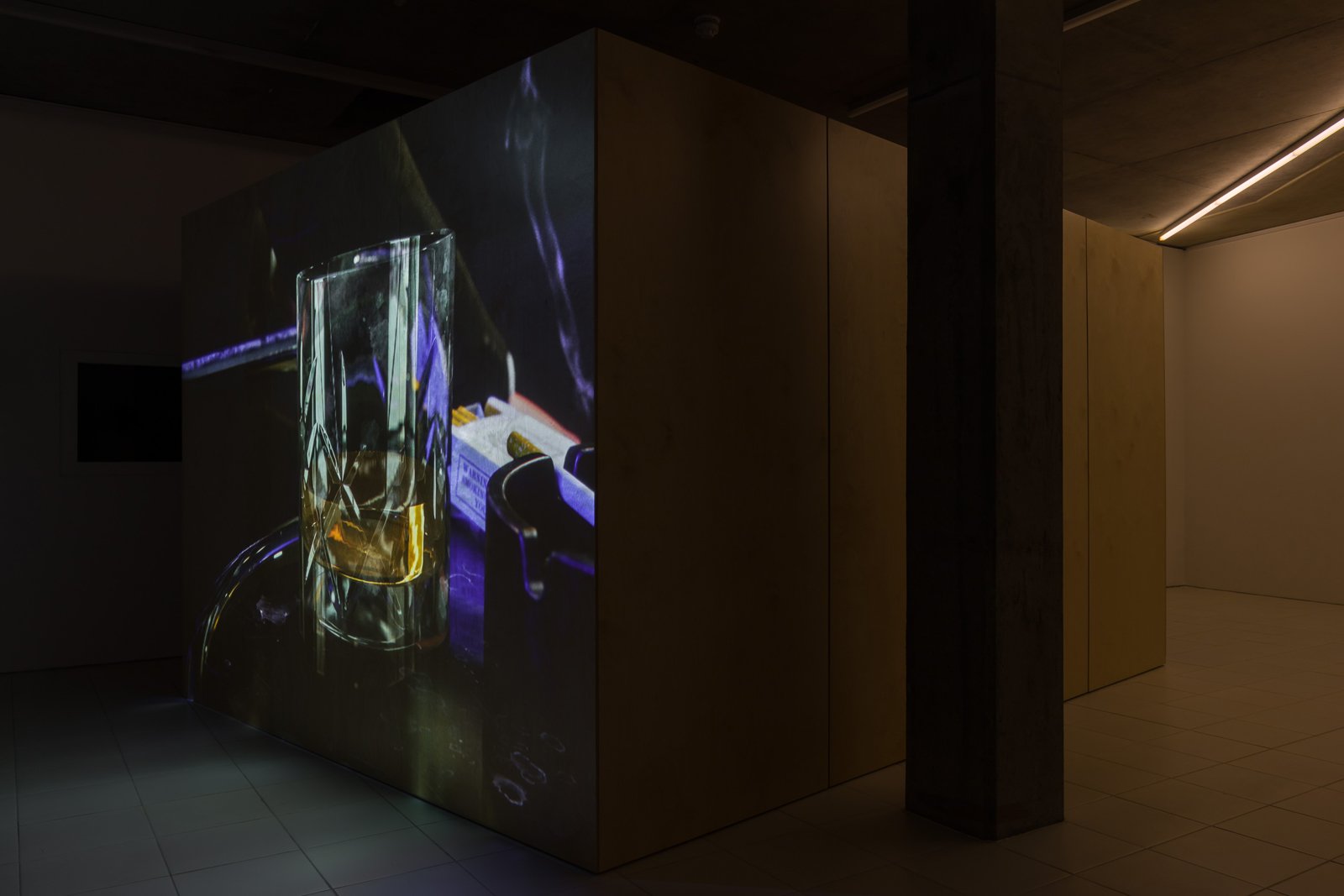
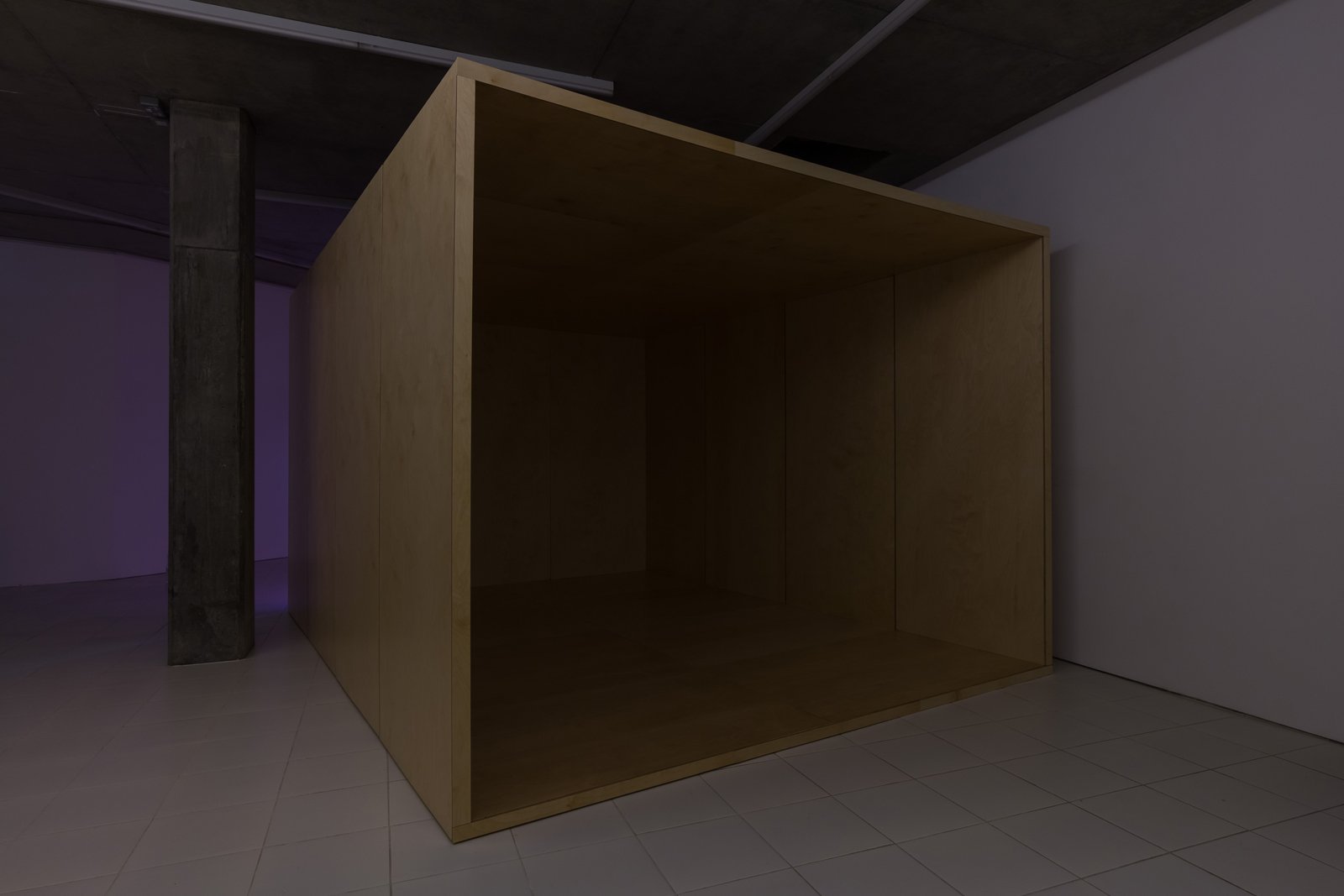
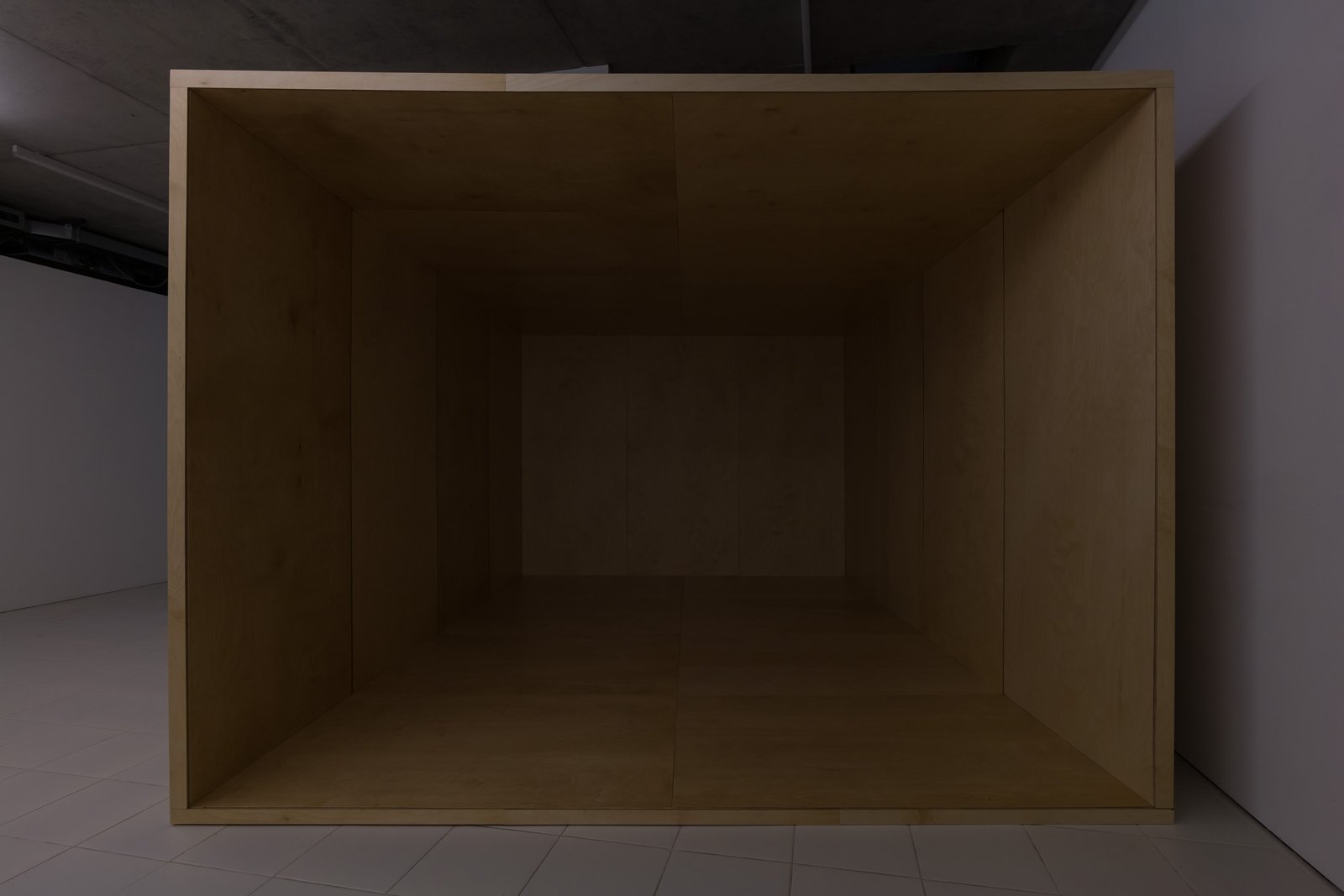
The Worm, 2021 Digital film, 4:3, colour, sound 12 minutes 39 seconds Edition of 8 + 2AP The worm is a computer-generated animation of a phone call between me and my Mum, Rosemary. She is on one end of the line, in England during one of the Covid-19 lockdowns. I'm in a Berlin hotel room, covered in motion capture sensors and monitored by two operators in the room next door. Our conversation is unscripted. We talk about Mum's relationship with her mother and the inheritance of a perceived unlovability. Feelings passively instilled across generations. This lineage is a worm – Mum refers to it this way in passing, as if it were a creature we all knew and named as such. I wanted the video to be an artificial documentary of something very much alive and utterly real. The digitally rendered TV studio and smartly dressed figure are references to the British screenwriter Dennis Potter's last TV interview with Melvyn Bragg in 1994, two months before he died from pancreatic cancer. In it, Potter talks astonishingly about dying and how it italicises the world. Perhaps most famously, he describes the blossom on a tree seen from his window as the 'blossomest blossom'. The worm is projected onto an empty birch plywood box, an ominous piece of obscure modular furniture. The video is accompanied by an incidental soundtrack called Love, which plays in the neighbouring room of the exhibition. Sound is everything. The particular quality of Mum's voice over the phone, the clunk of my mic as I shift position or scratch my nose. Absence and presence, weight, and touch are all reported. In my animations, sound is often a source of excessive, compensatory, confessional materiality.
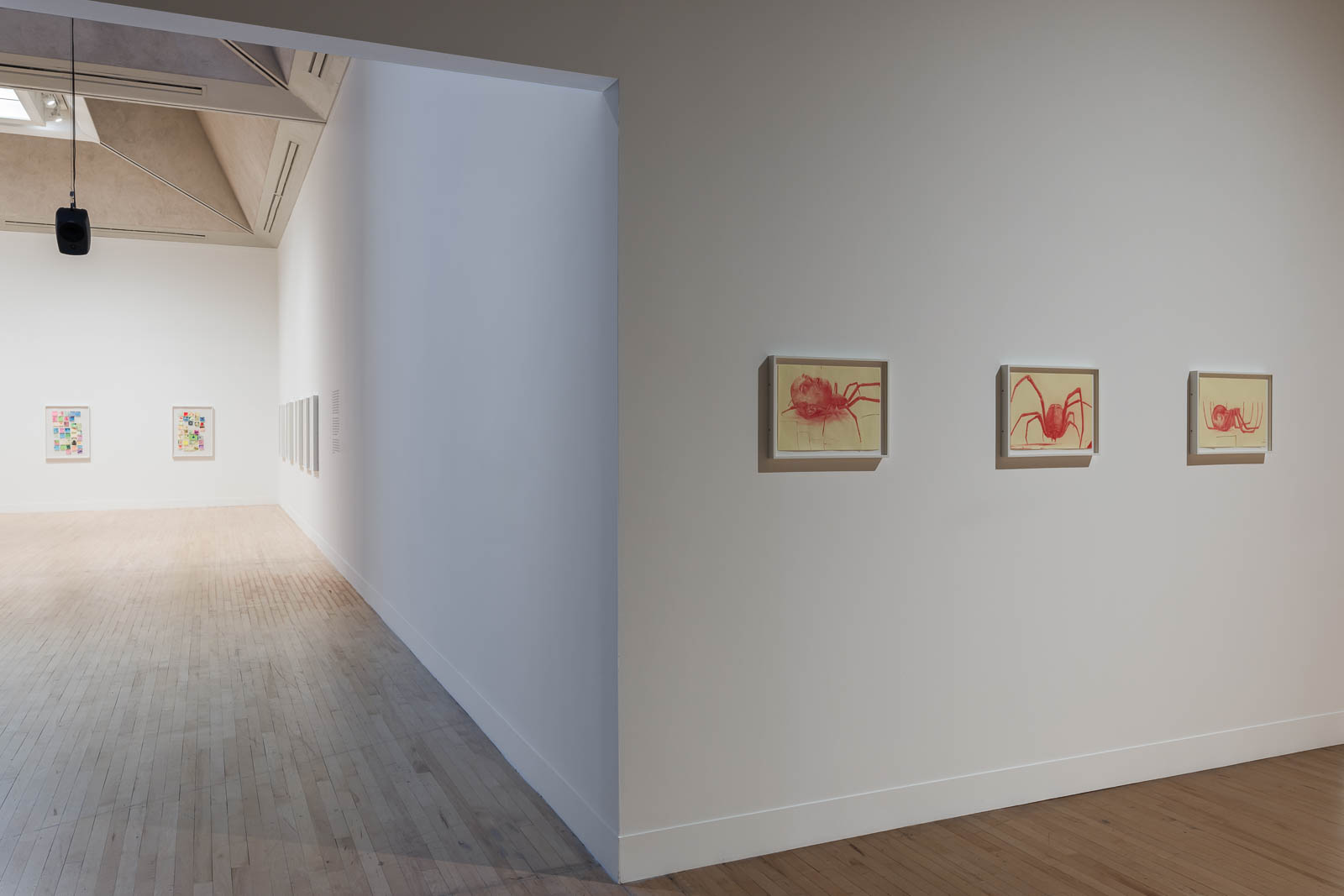
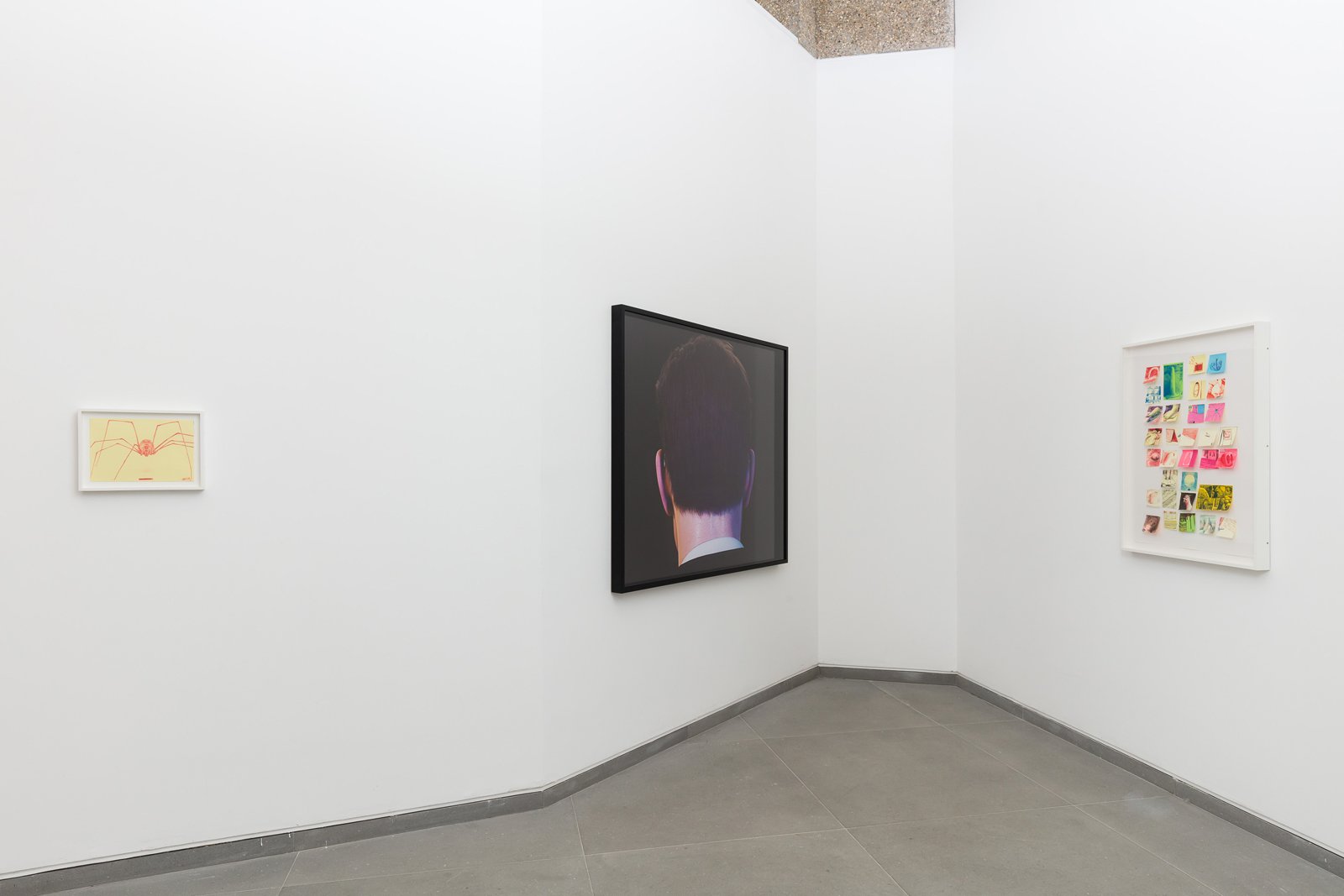
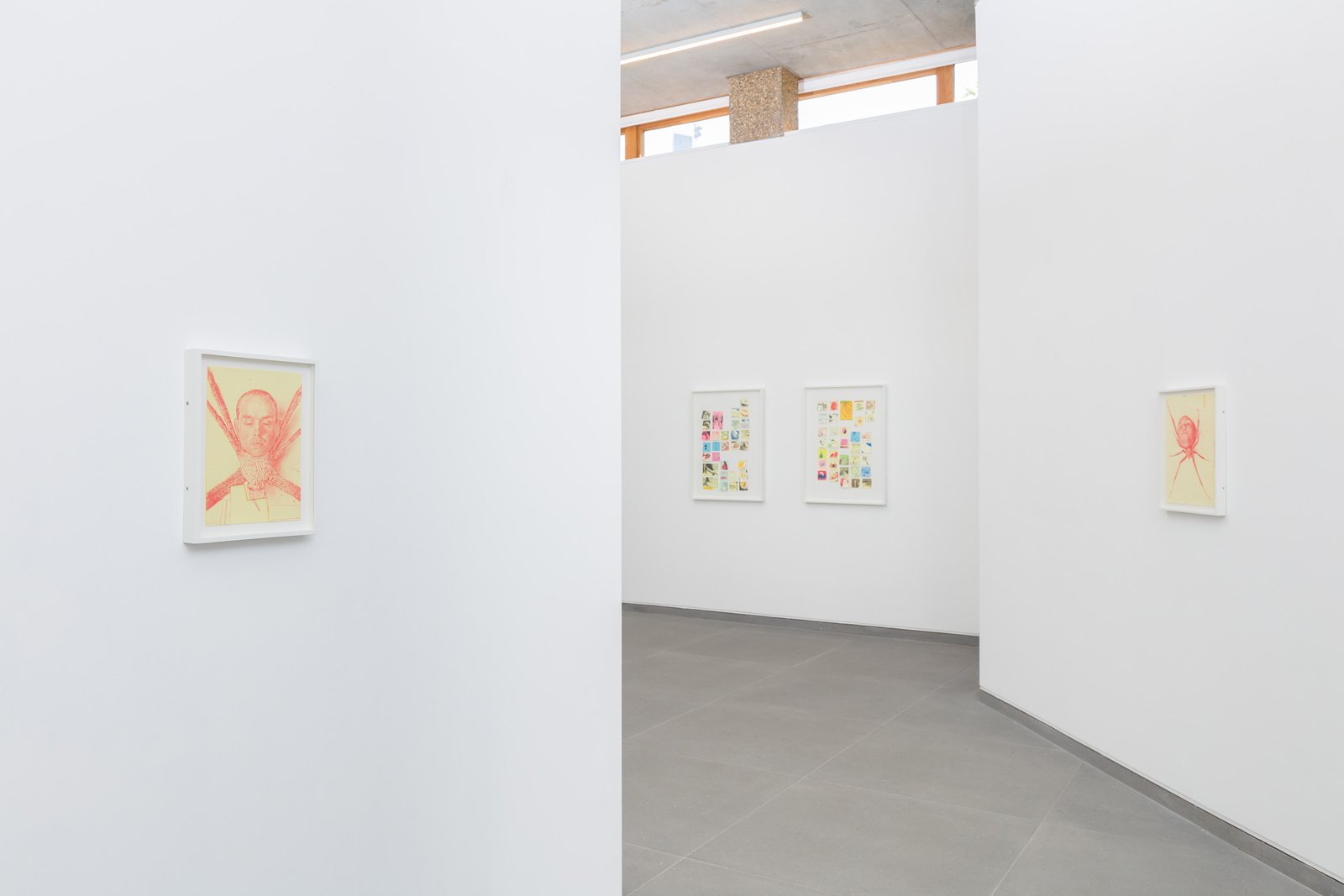
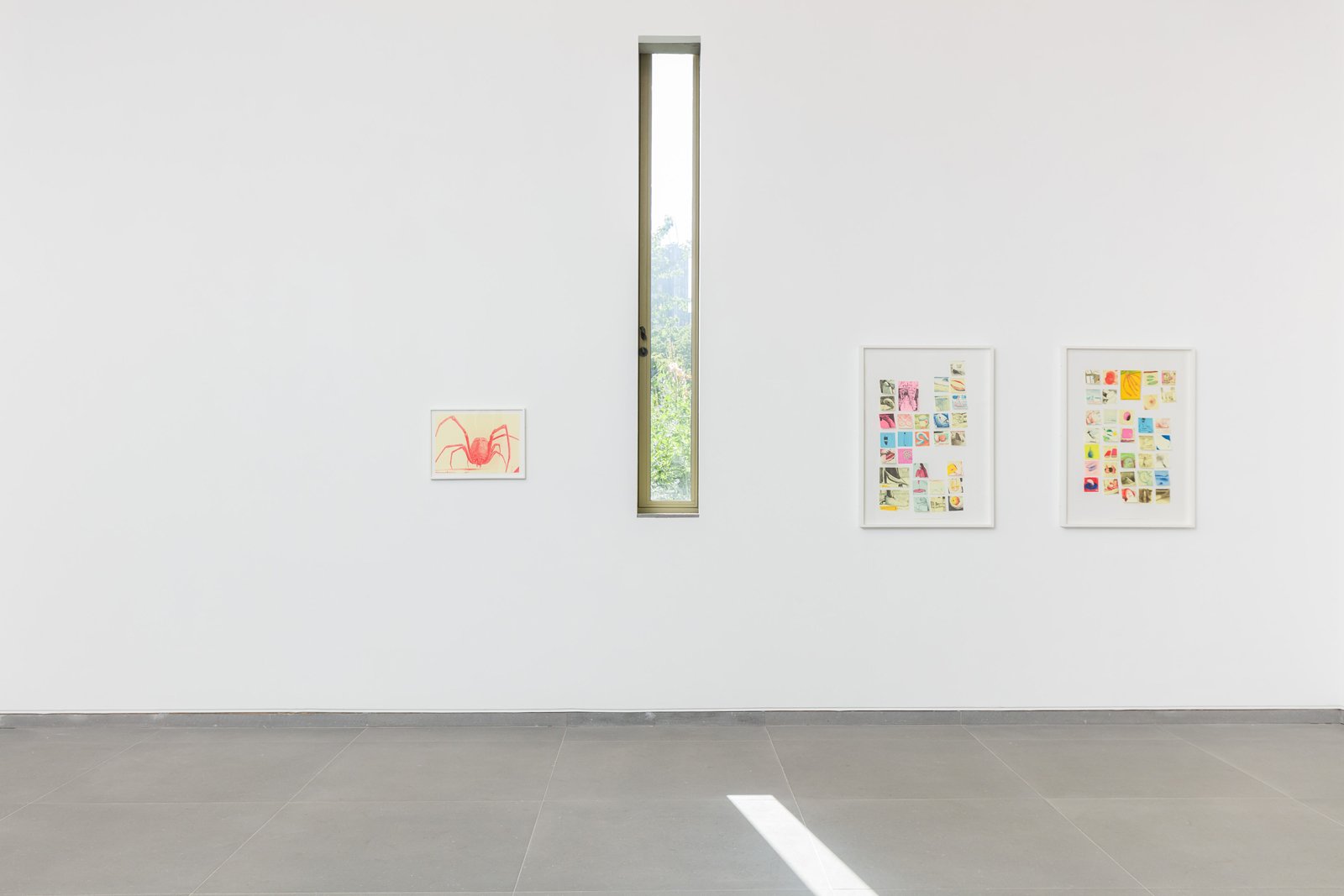
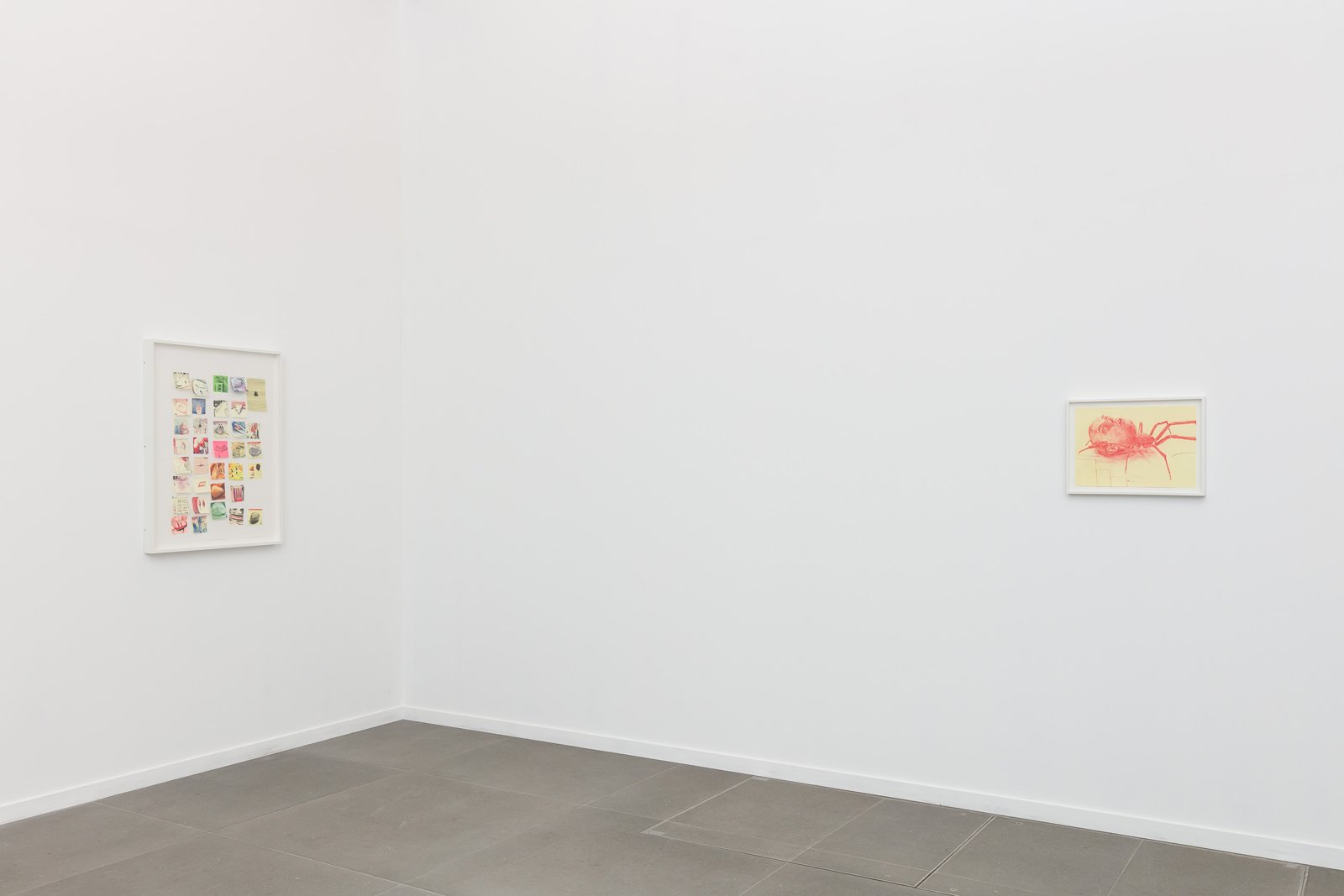
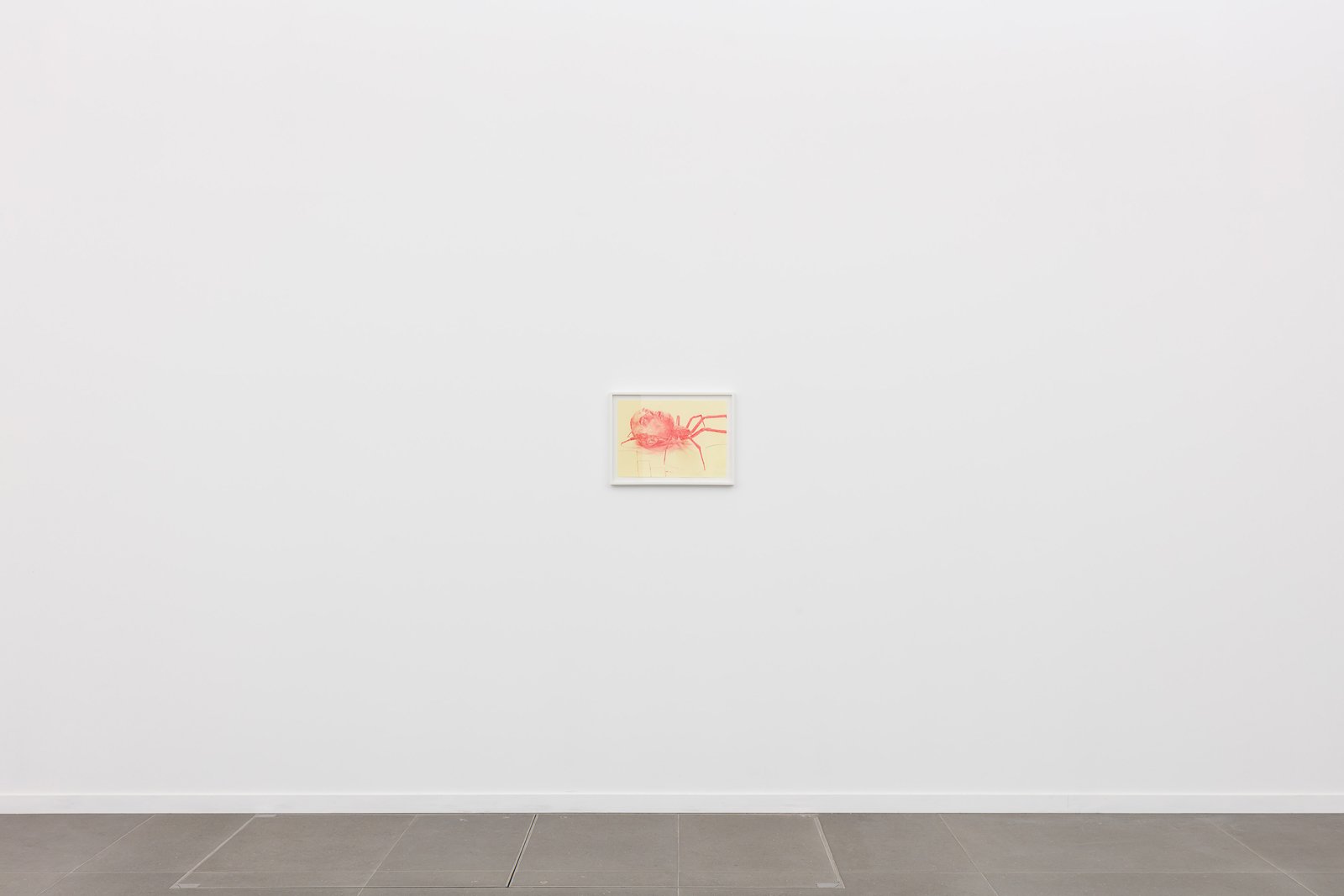
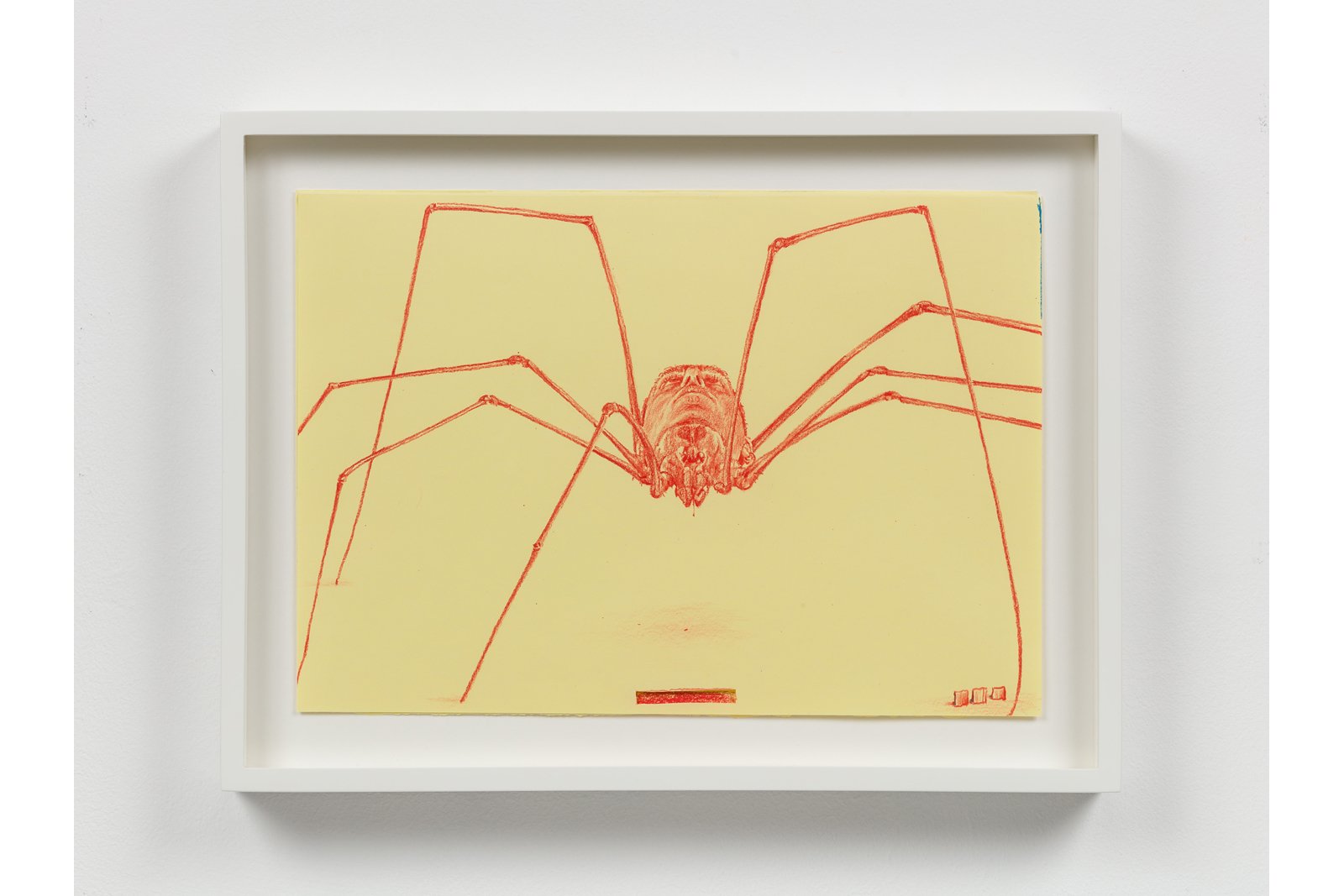
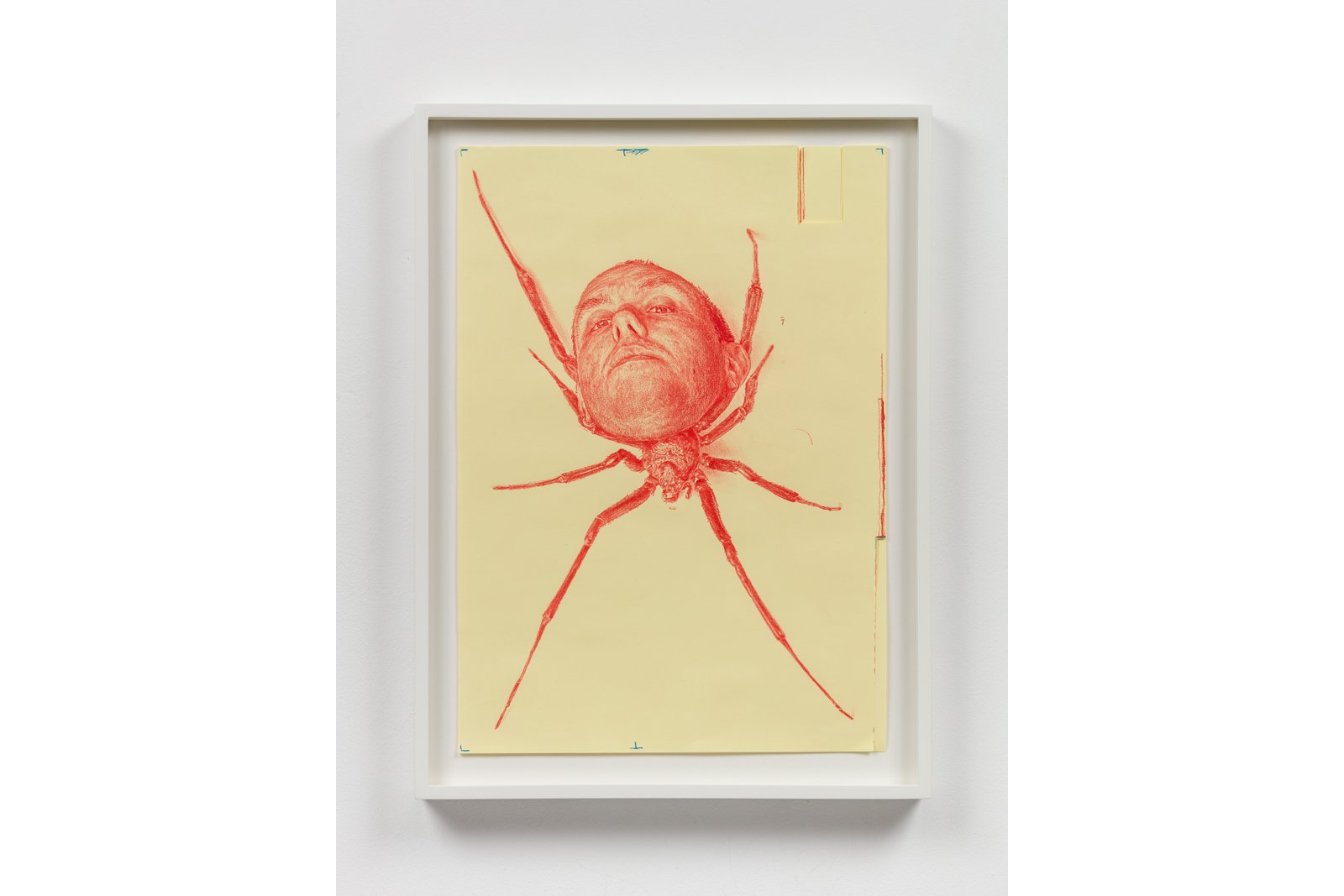
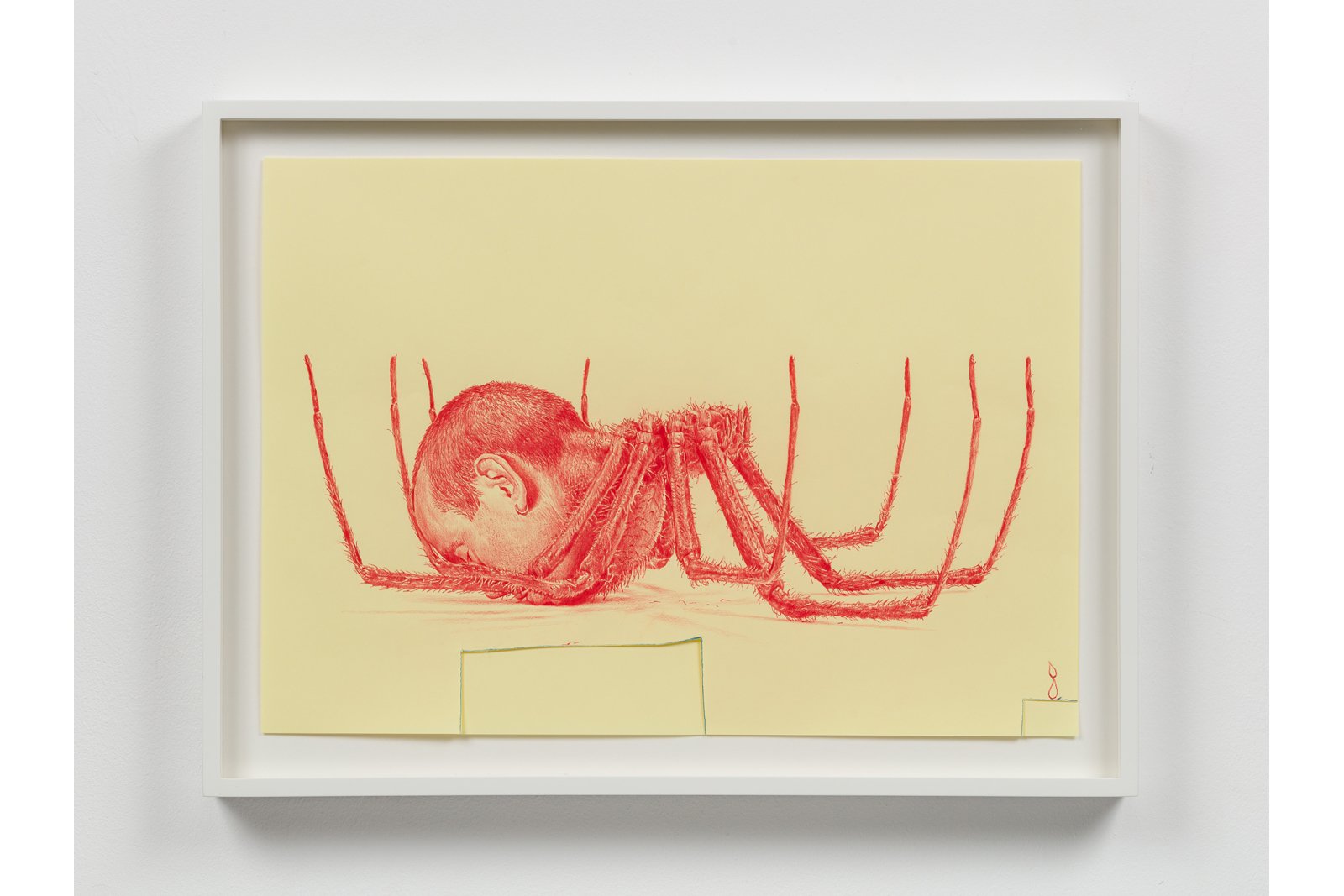
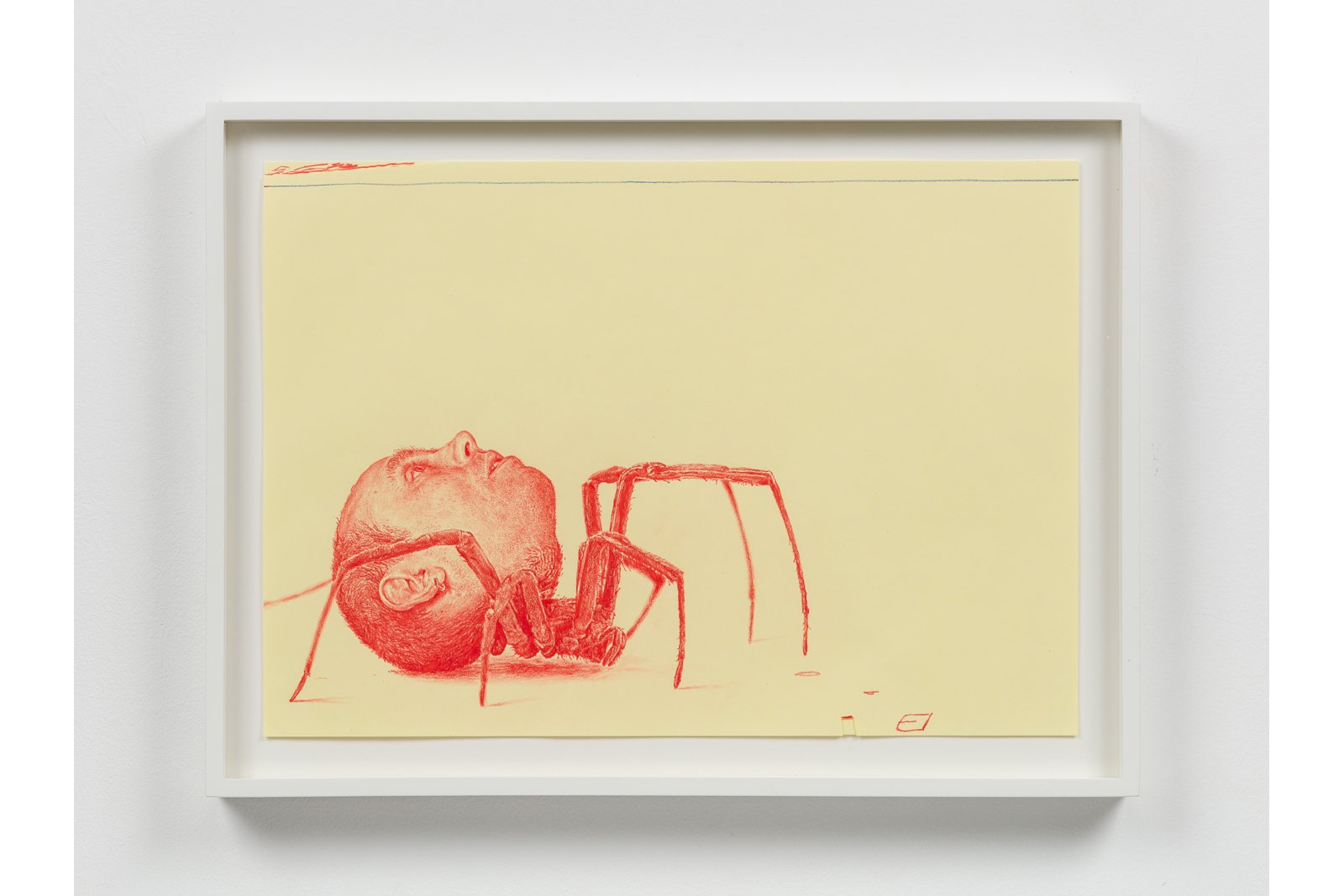
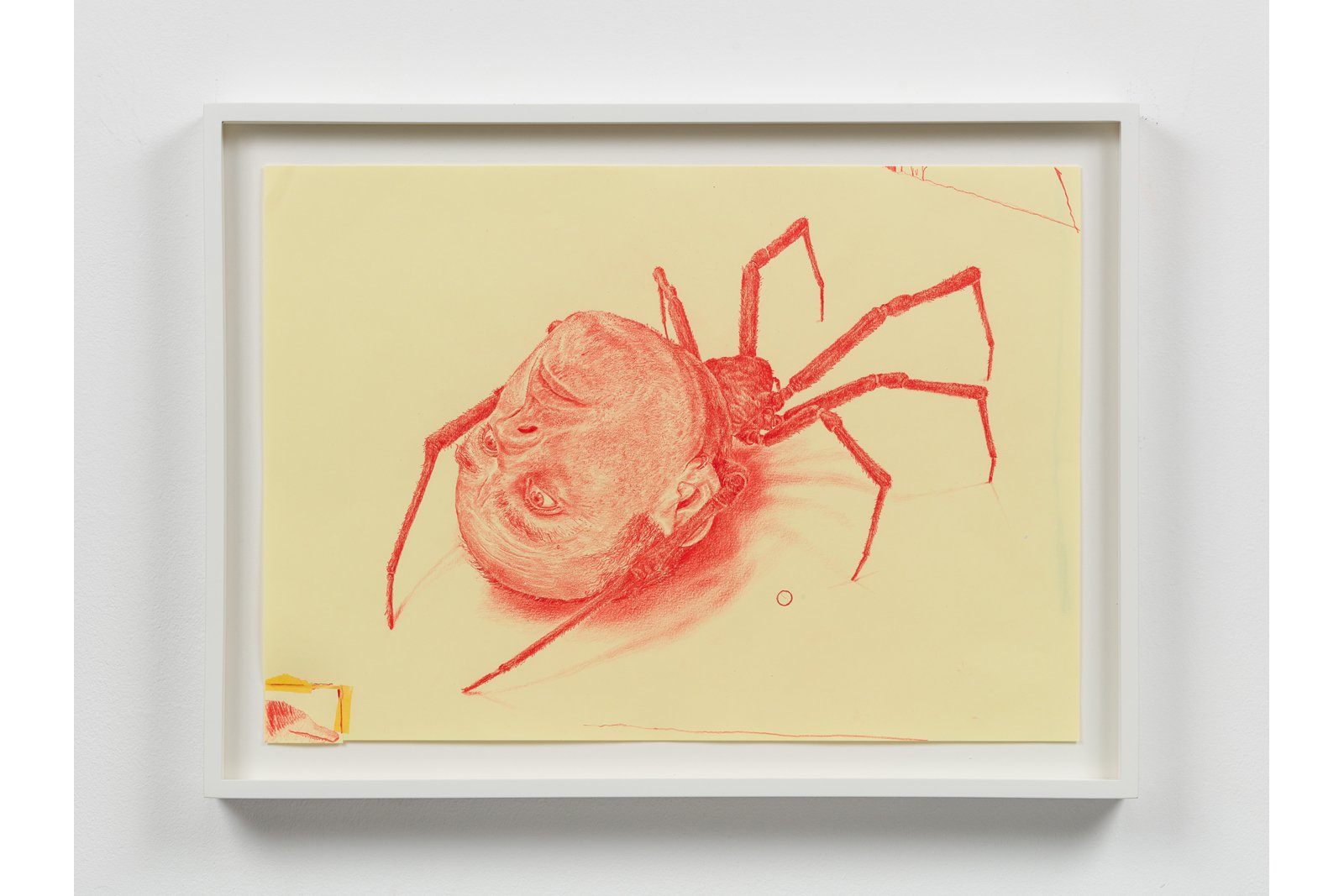
Untitled, 2023 Coloured pencil on paper The drawings in this series are self-portraits as awful spiders, some dead. I'm trying to take the realism of my self portraits and confuse it with something drastically other. Spiders stand in for all kinds of fears, myths, histories and psychological crises. They're formless, like spit, and my self-identification with them is ultimately alien. I recall a scene from the 1978 film Invasion of the Bodysnatchers where a botched bodysnatcher comes running up to the protagonist: a dog with a man's face. My expression here carries the same blank feeling – any trace of human psychology is a misrecognition on the part of the viewer.
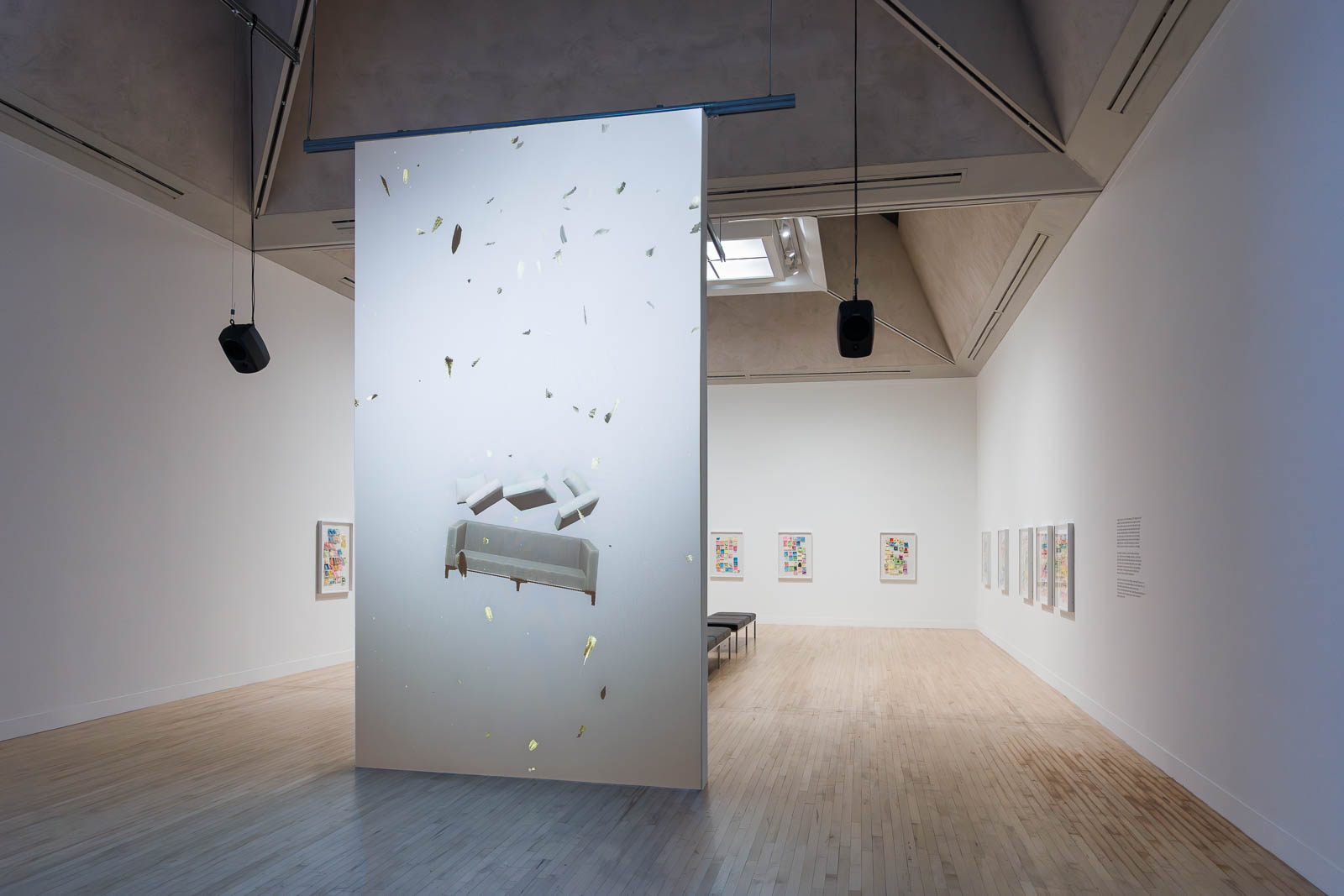
Refuse.exe (Upper screen), 2019 Two-channel realtime 3D simulation authored in a custom version of the Unreal Engine Edition of 8 This is the upper screen of Refuse.exe. The lower half is installed in an earlier room of the exhibition. Here, trash falls in heavenly peace, the violence of impact deferred. There's respite in this suspension, even if the end is already known. It reminds me of 'the cloud': digital storage kept out of sight, impossibly immaterial to the consumer. In reality, massive servers and data centres are gobbling up the world.
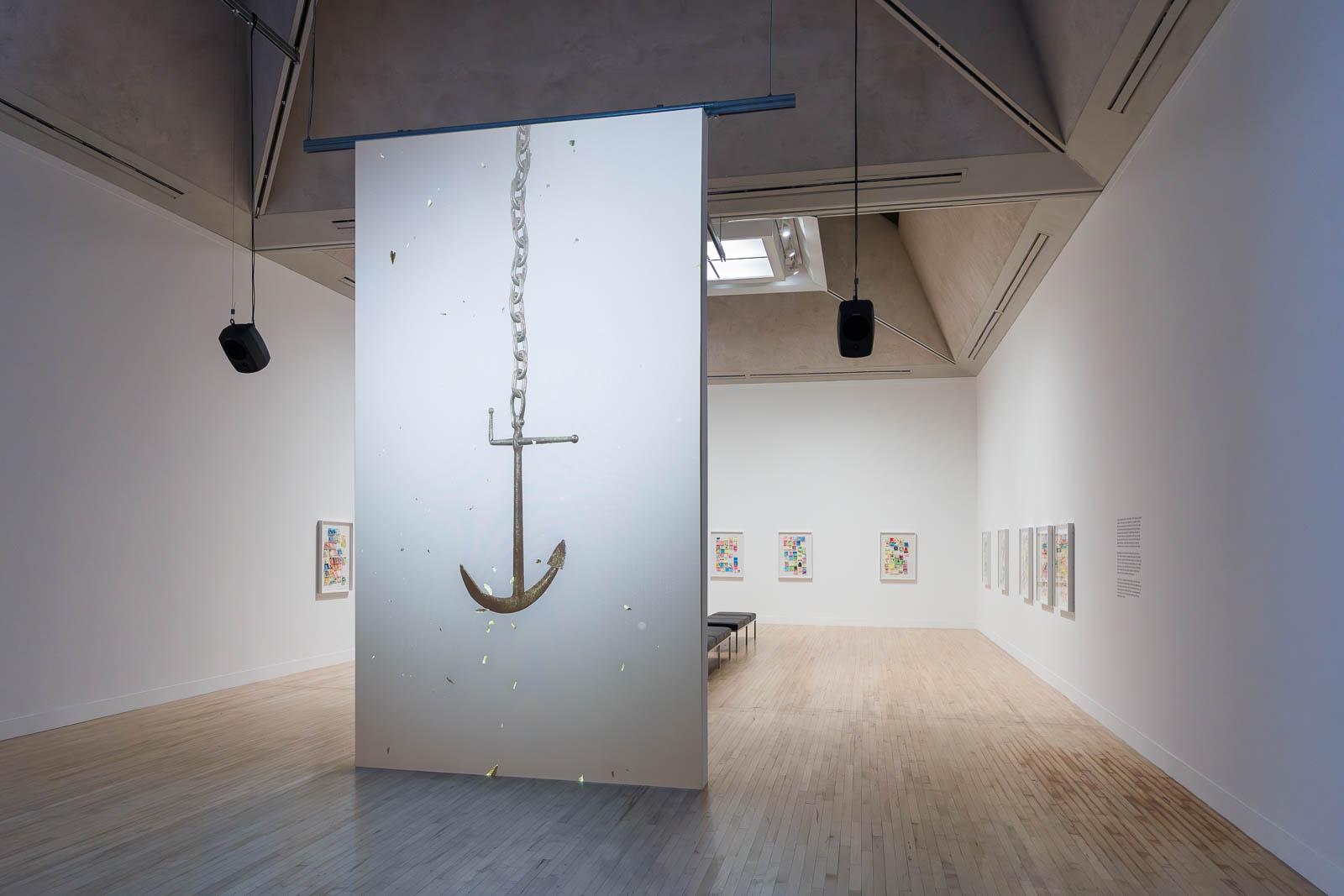
Refuse.exe (Upper screen), 2019 Two-channel realtime 3D simulation authored in a custom version of the Unreal Engine Edition of 8
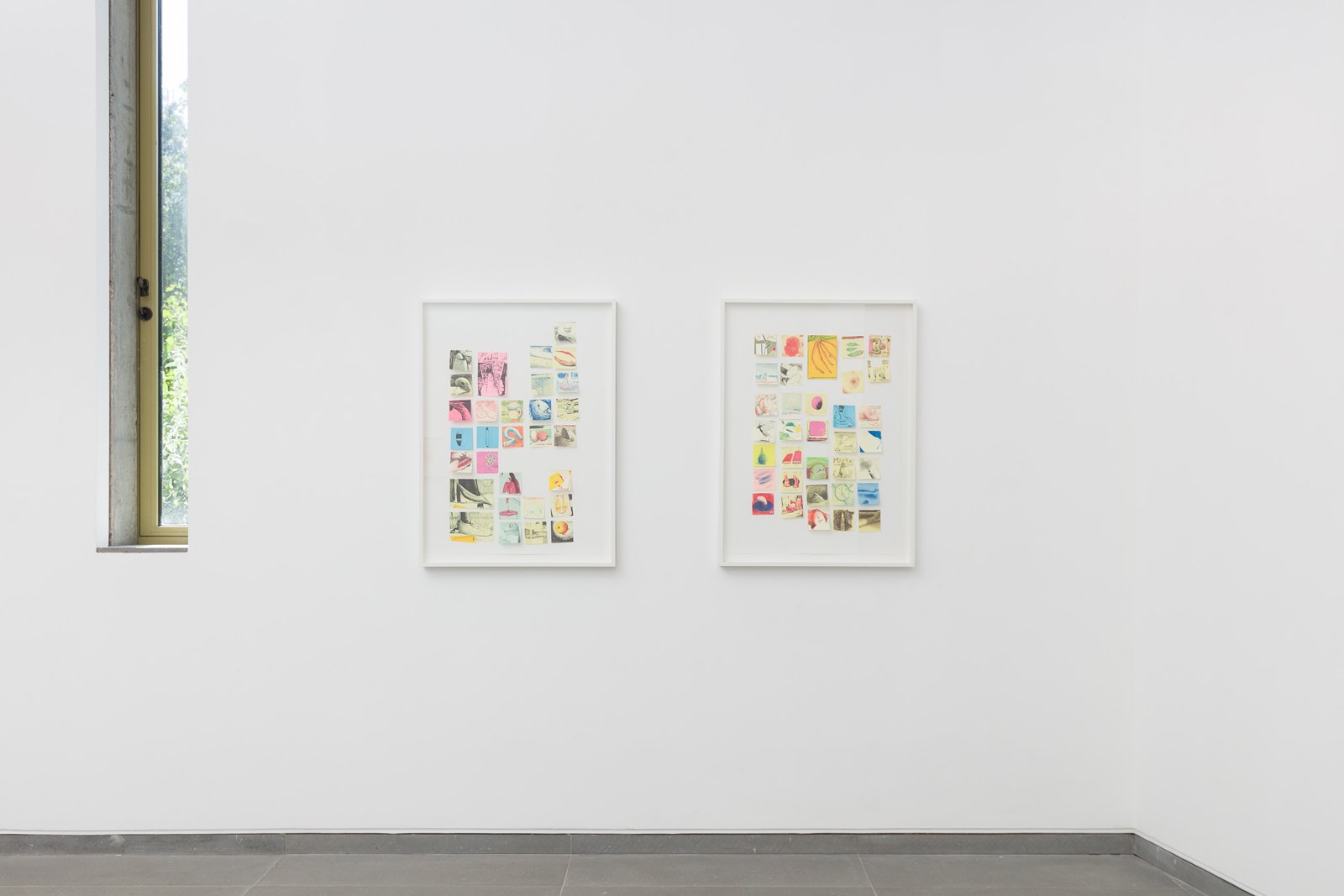
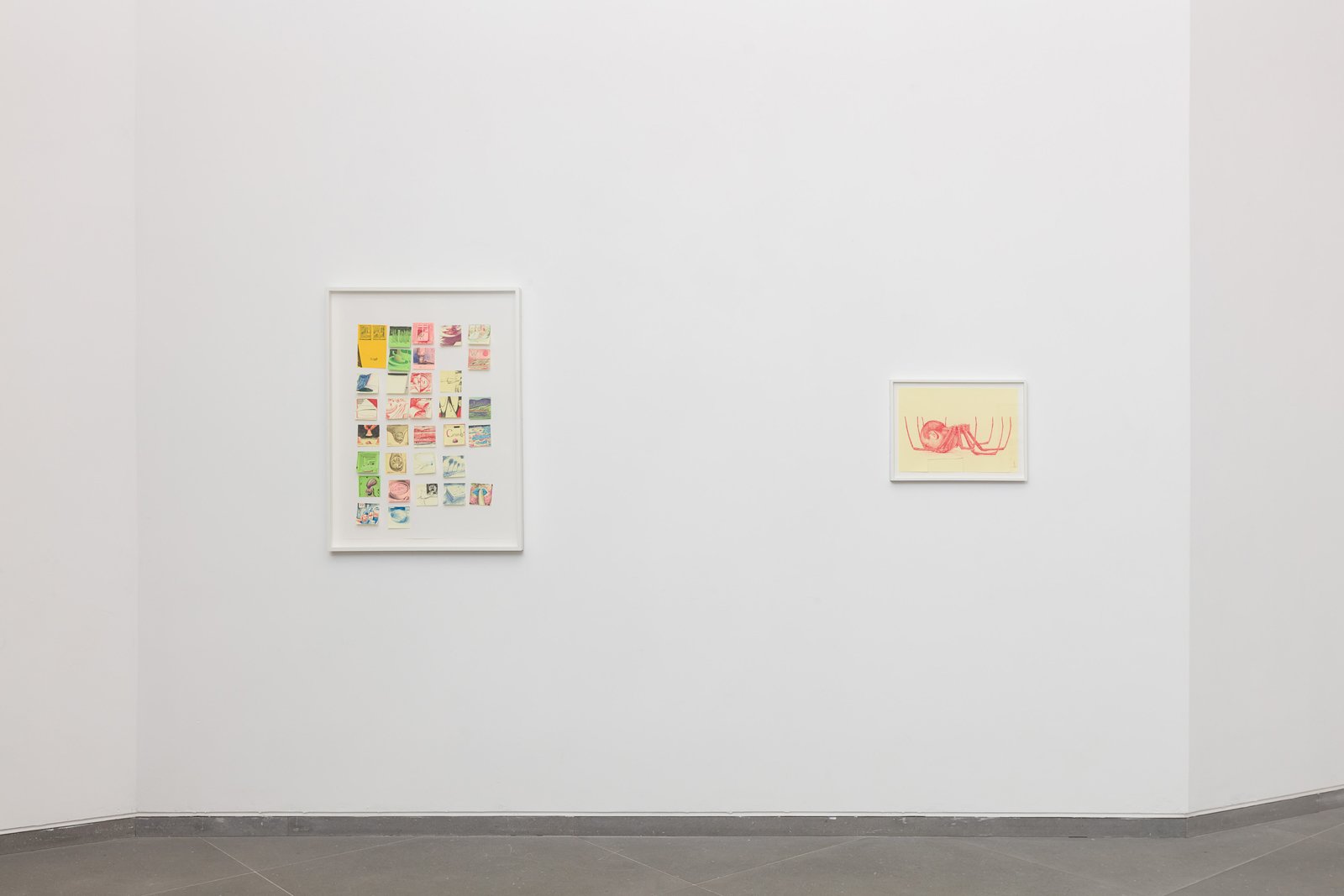
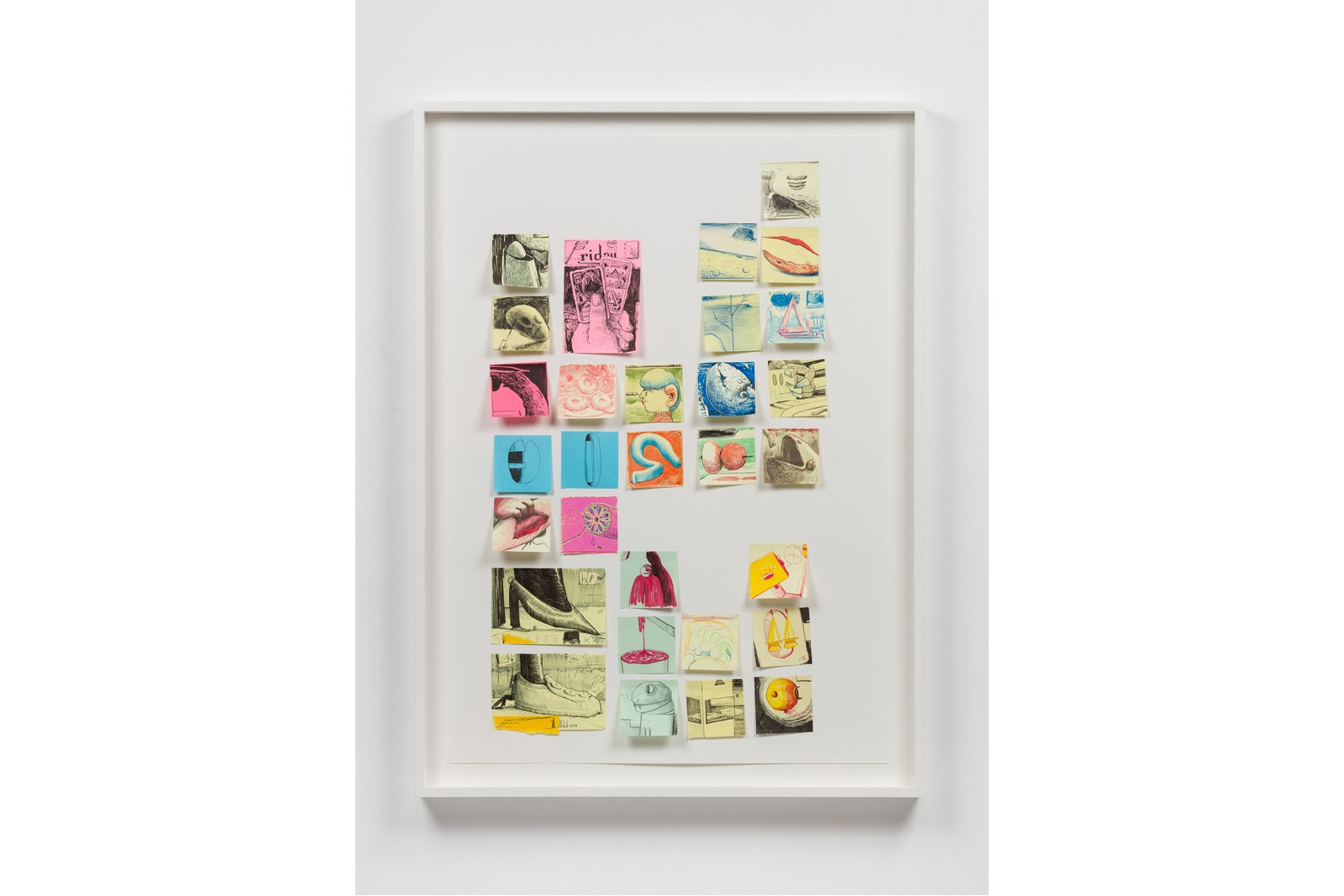
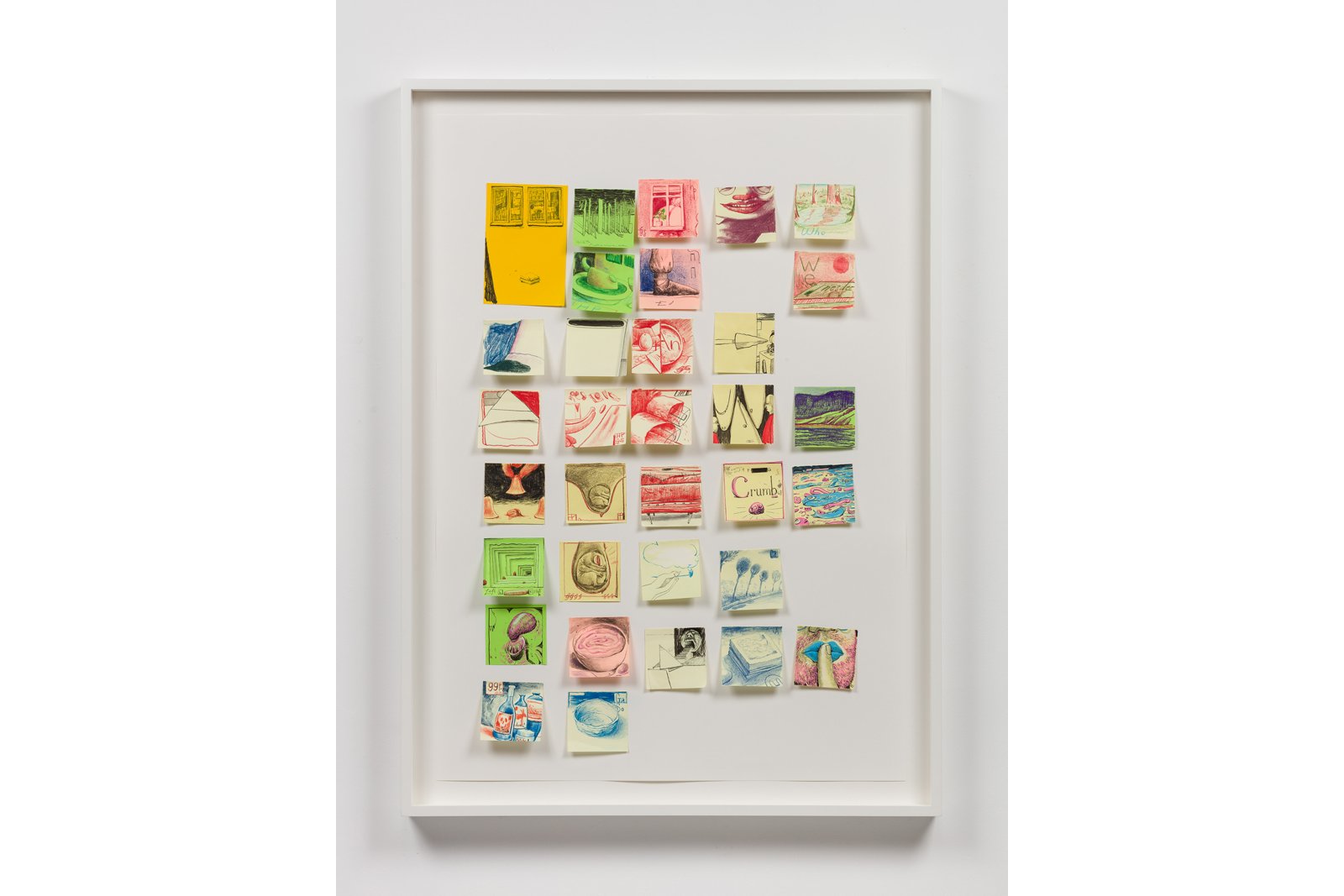
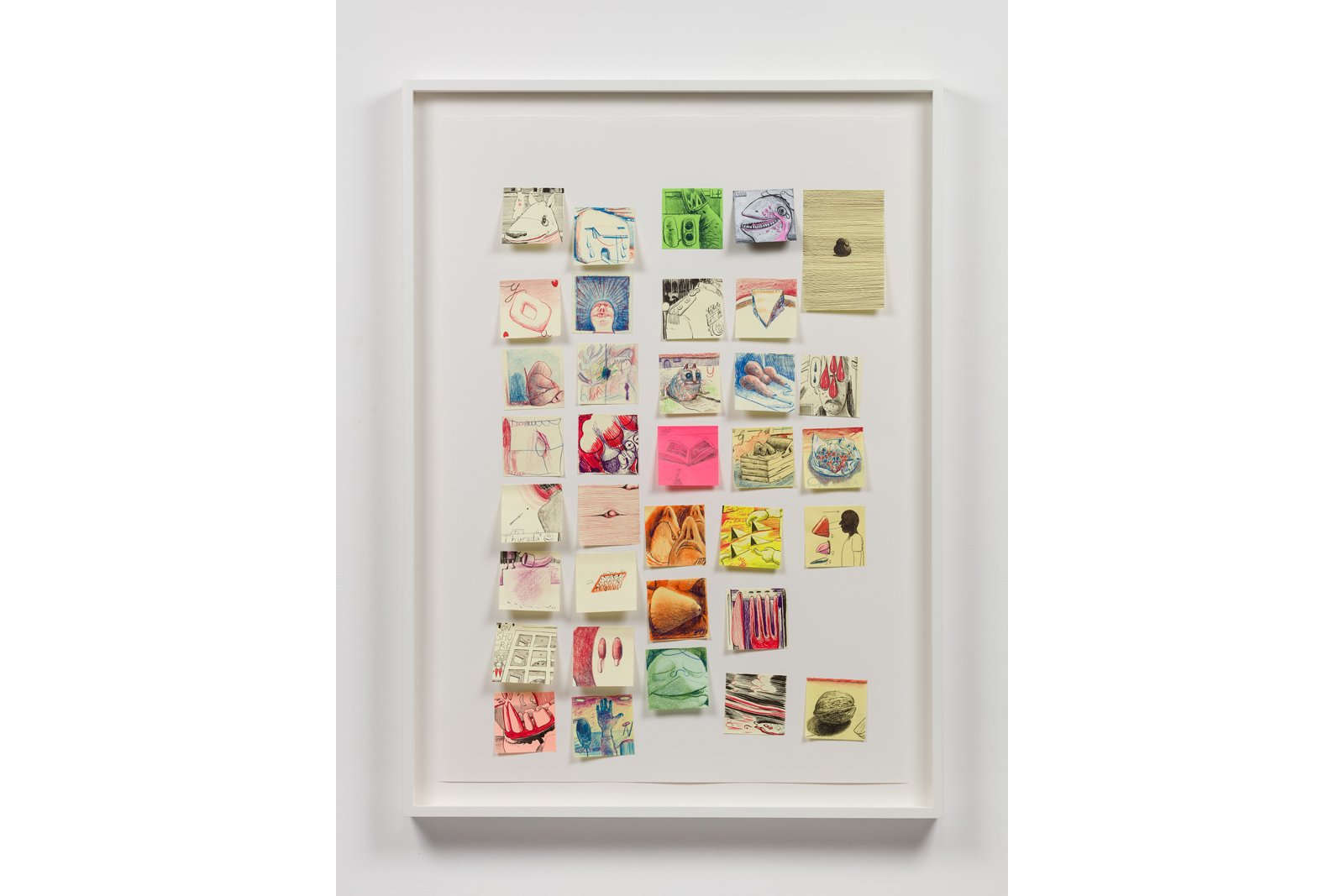
I began making these Post-it note drawings in 2020, during the Covid-19 pandemic. They started as daily additions to my daughter's lunchbox. Little hellos, little irruptions of love into her day. They were also a way for me to achieve something. Everything I was working on had been cancelled or indefinitely postponed, so the drawings were often the only things I'd make in a day. Unburdened by pretty much anything, they accrued their own importance. I would retrieve them when my daughter got home – often blotched and warped by a satsuma or softened by proximity to a banana – and keep them in a little folder.
My daughter is not impressed or moved by projected significance; she is a child. Her sense of the drawings' preciousness, or lack thereof, quickly made it apparent that they were mainly for me. I still make them for her, but as with so many gestures towards children, there is a latent unrequitedness I must accept and even enjoy. So much of parenting is sweet mourning – for each and every moment of a child's life that leaves, never to return, replaced by something new.
I think the Post-it drawings are the best things I've ever made. The excuse for their production is unquestionable, founded as it is in love. Their reach towards a marred infinite is also utterly devotional. The designs are desirous, improvised, expedient and dreamy – allied with good dreams. They are divine to me, the cryptic legend at the bottom of the map of this exhibition, and of my life.
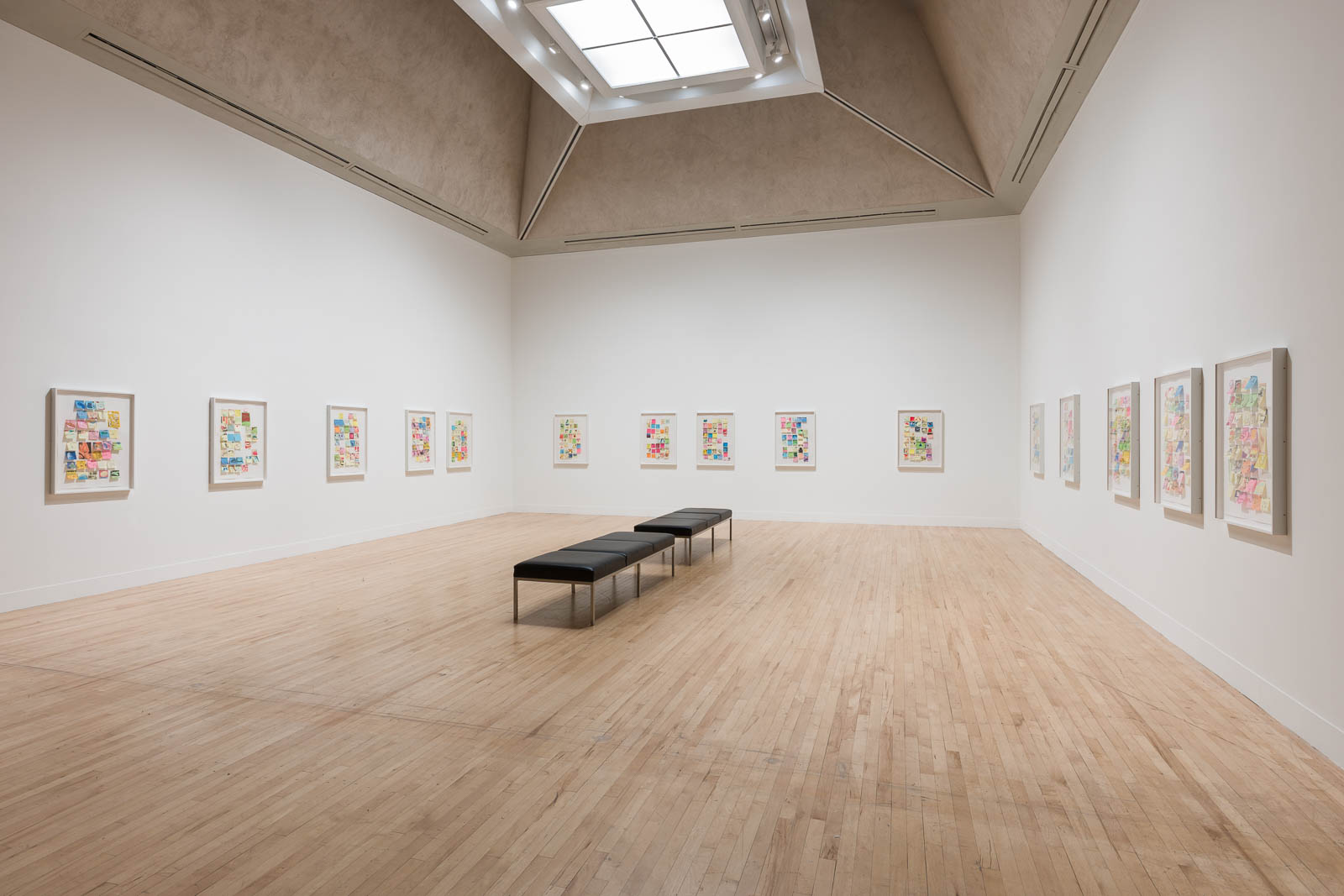
Children, 2025
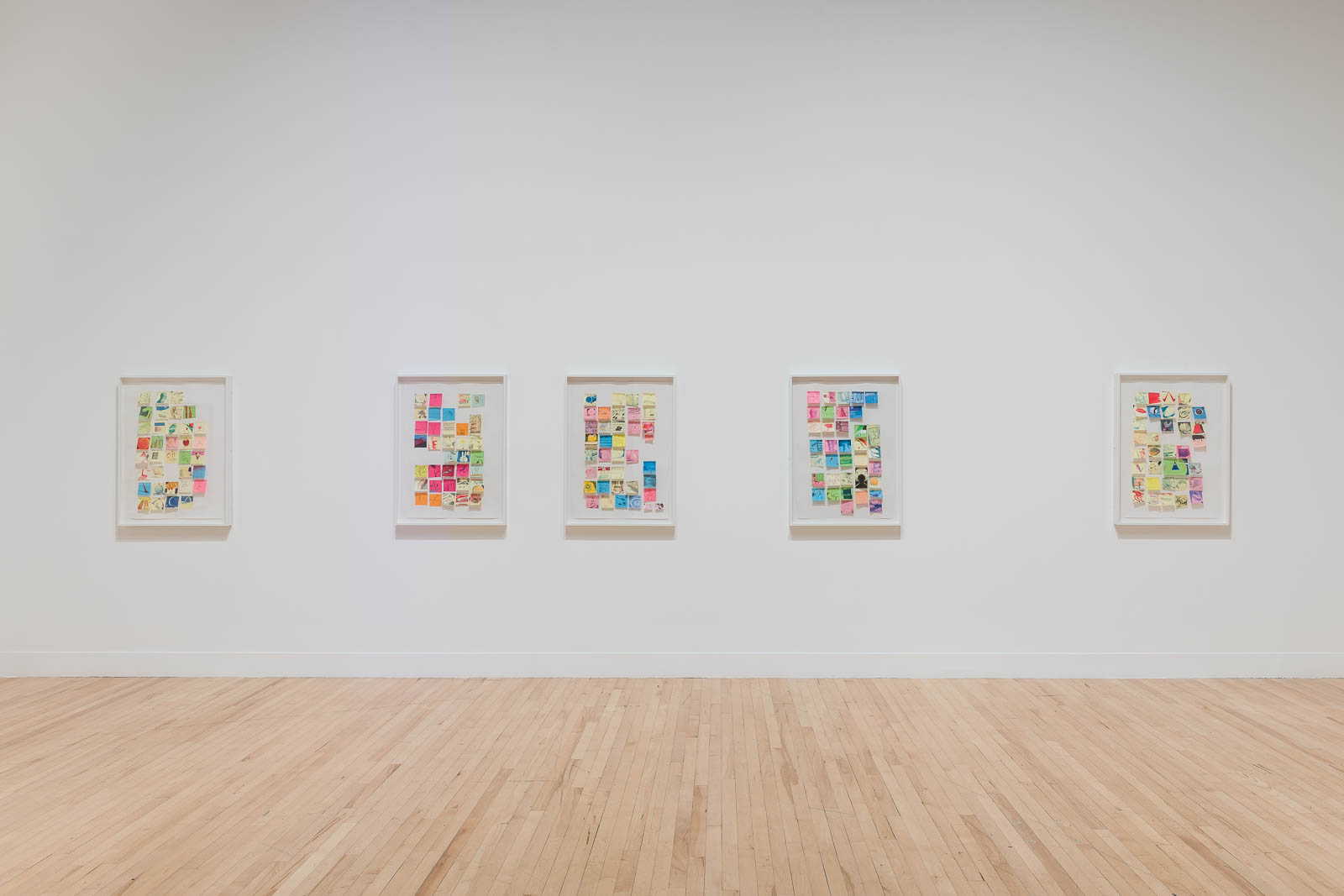
Children, 2025
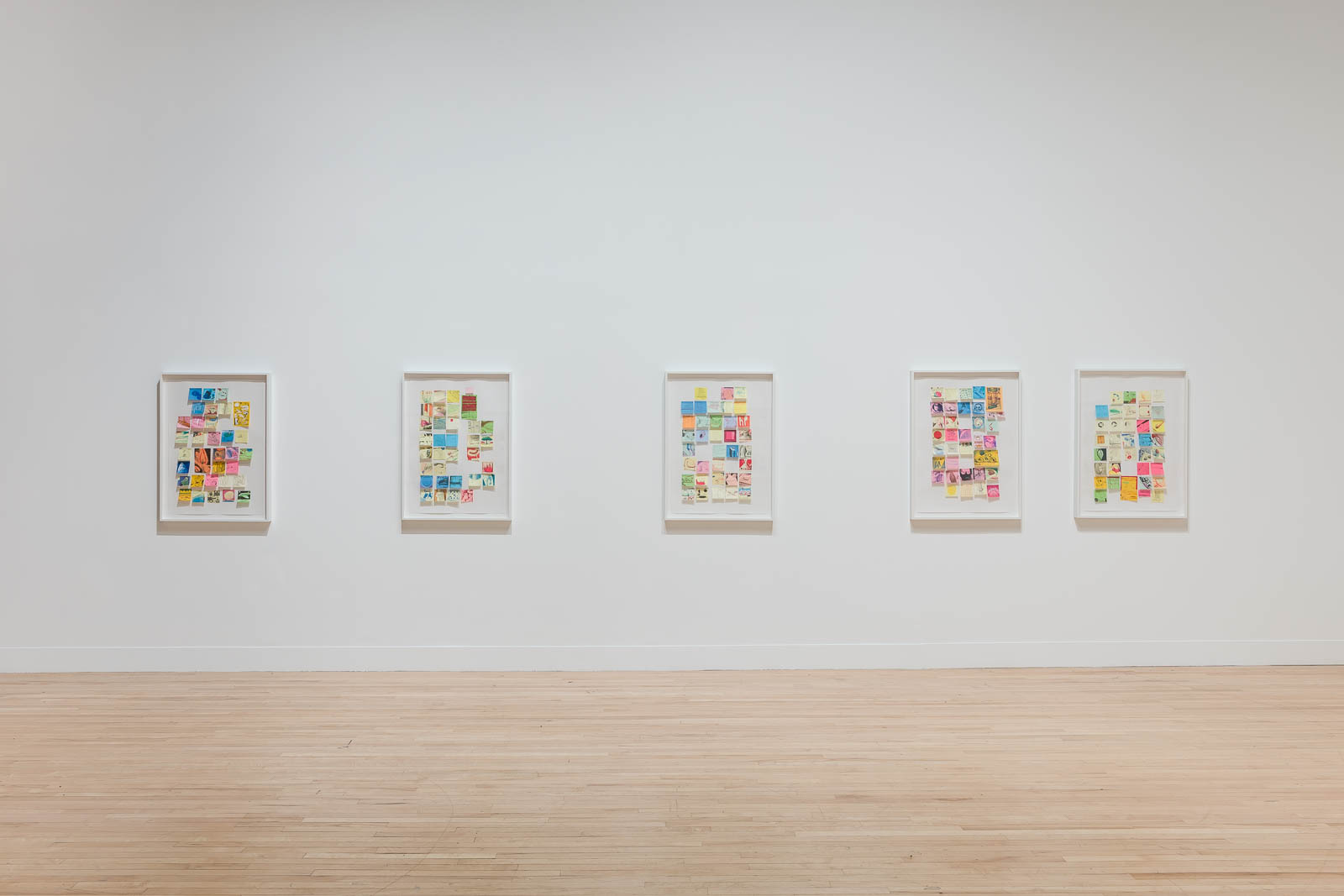
Children, 2025
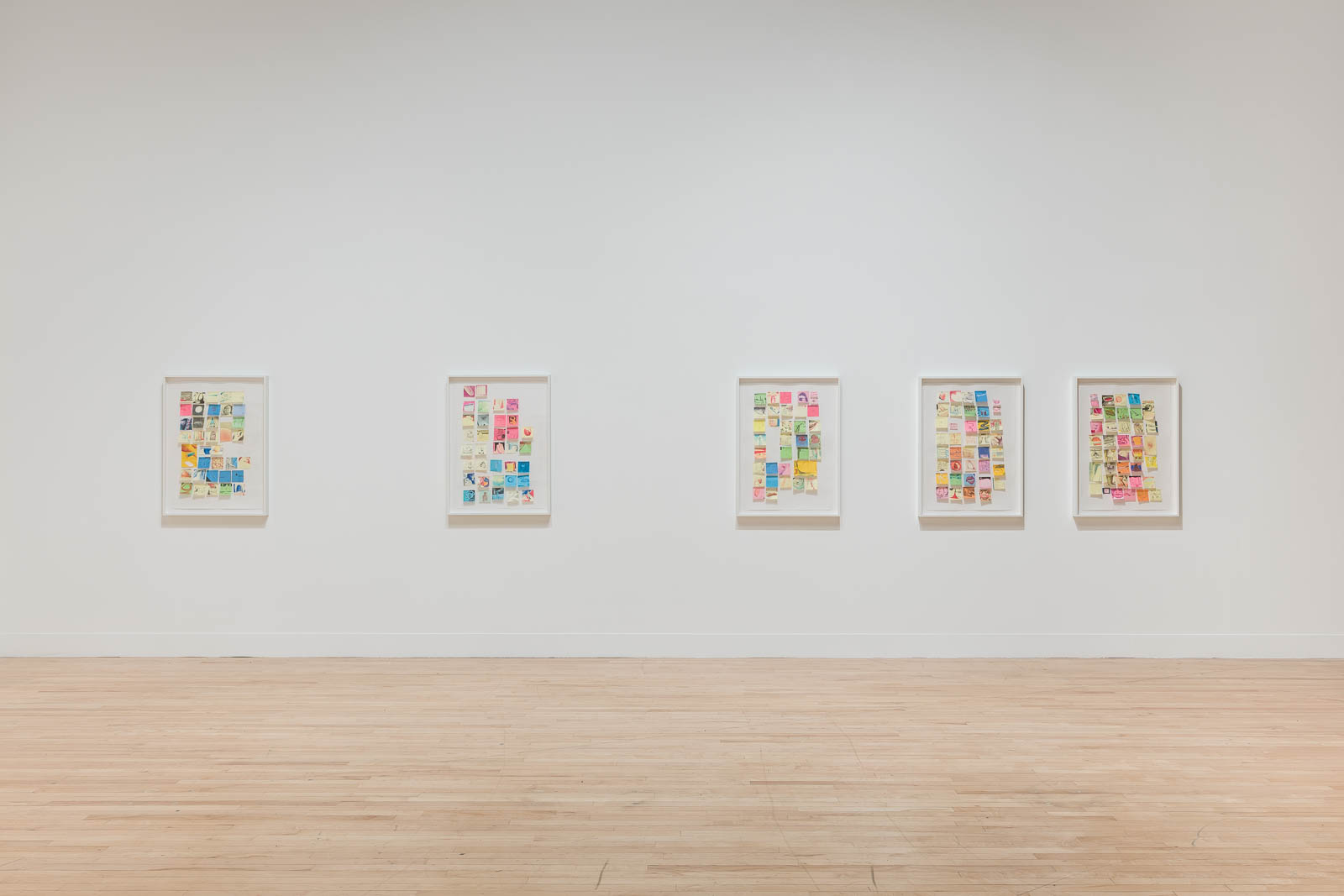
Children, 2025
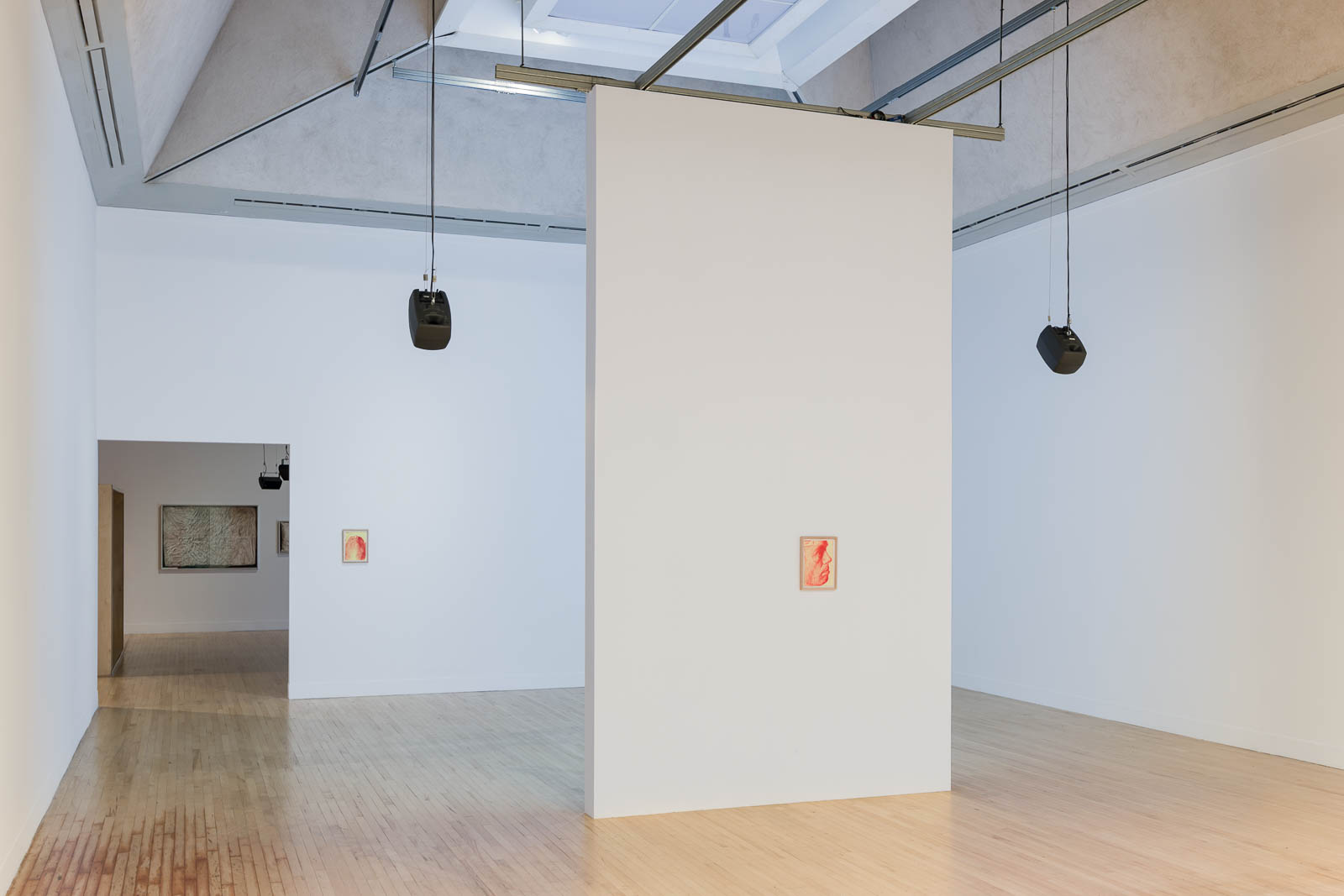
Untitled, 2023 Pencil on paper To make these drawings I set up a series of mirrors and spent hours scrutinising my alien face from many unflattering angles. The process was liberating. I wasn't encountering the shock of a glimpsed reflection. I was calm and detached. I had a job to do: to draw the thing in the mirror. The finished drawings still hold some horror for me, but the process opens a distance that allows me to cope. They act as masks, again. Plenty of the poses are corpselike, but that was mainly unconscious.
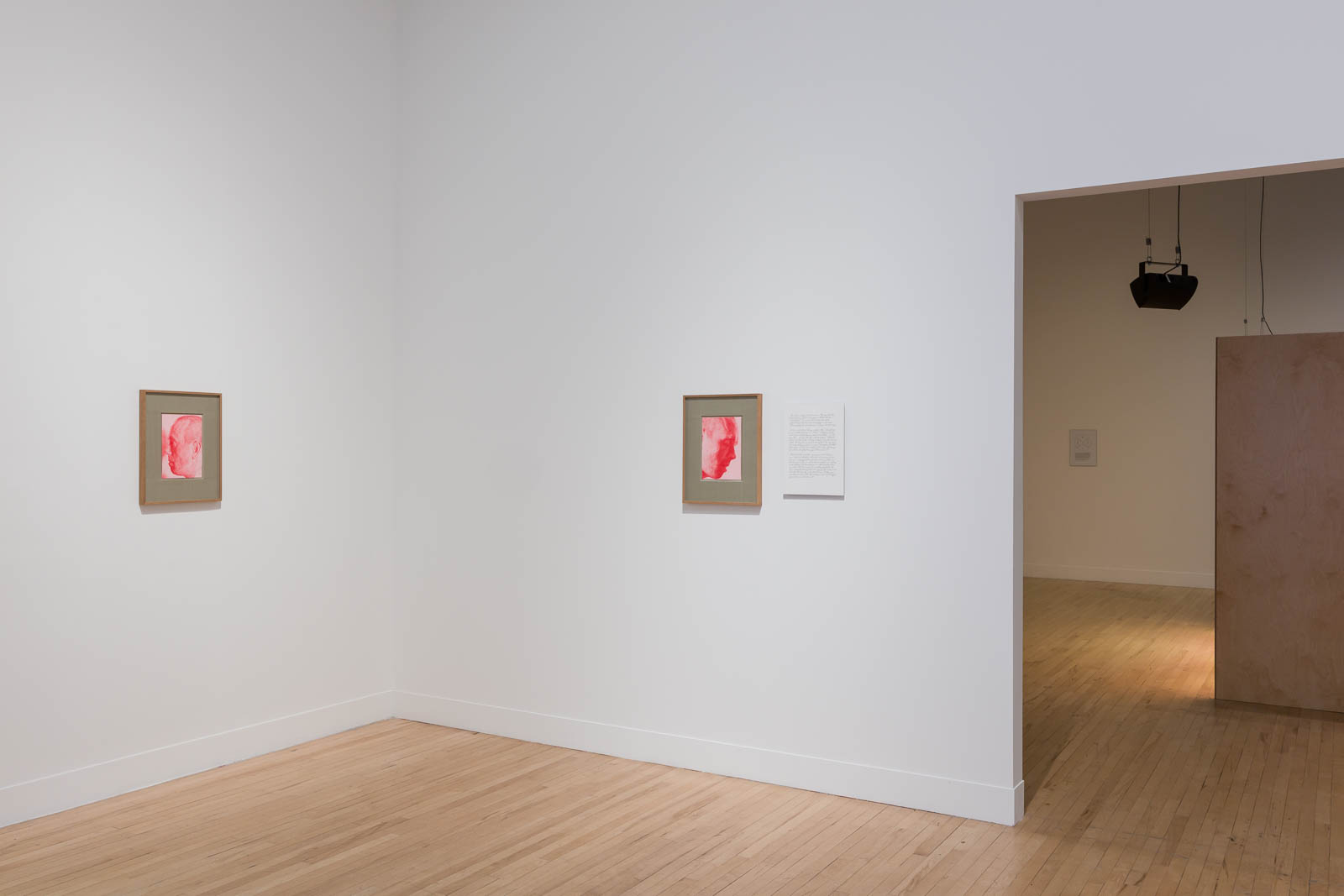
Untitled, 2023 Pencil on paper
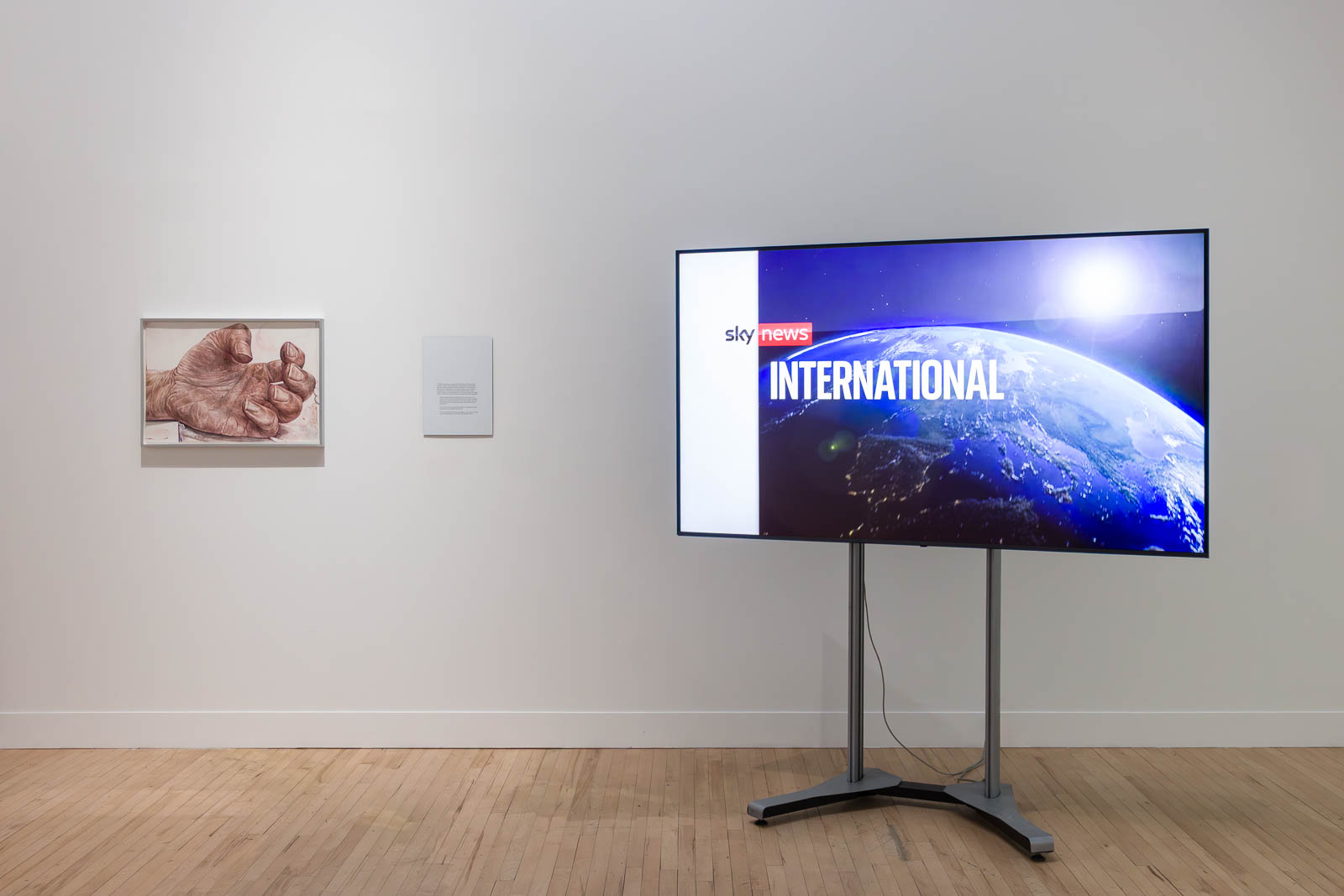
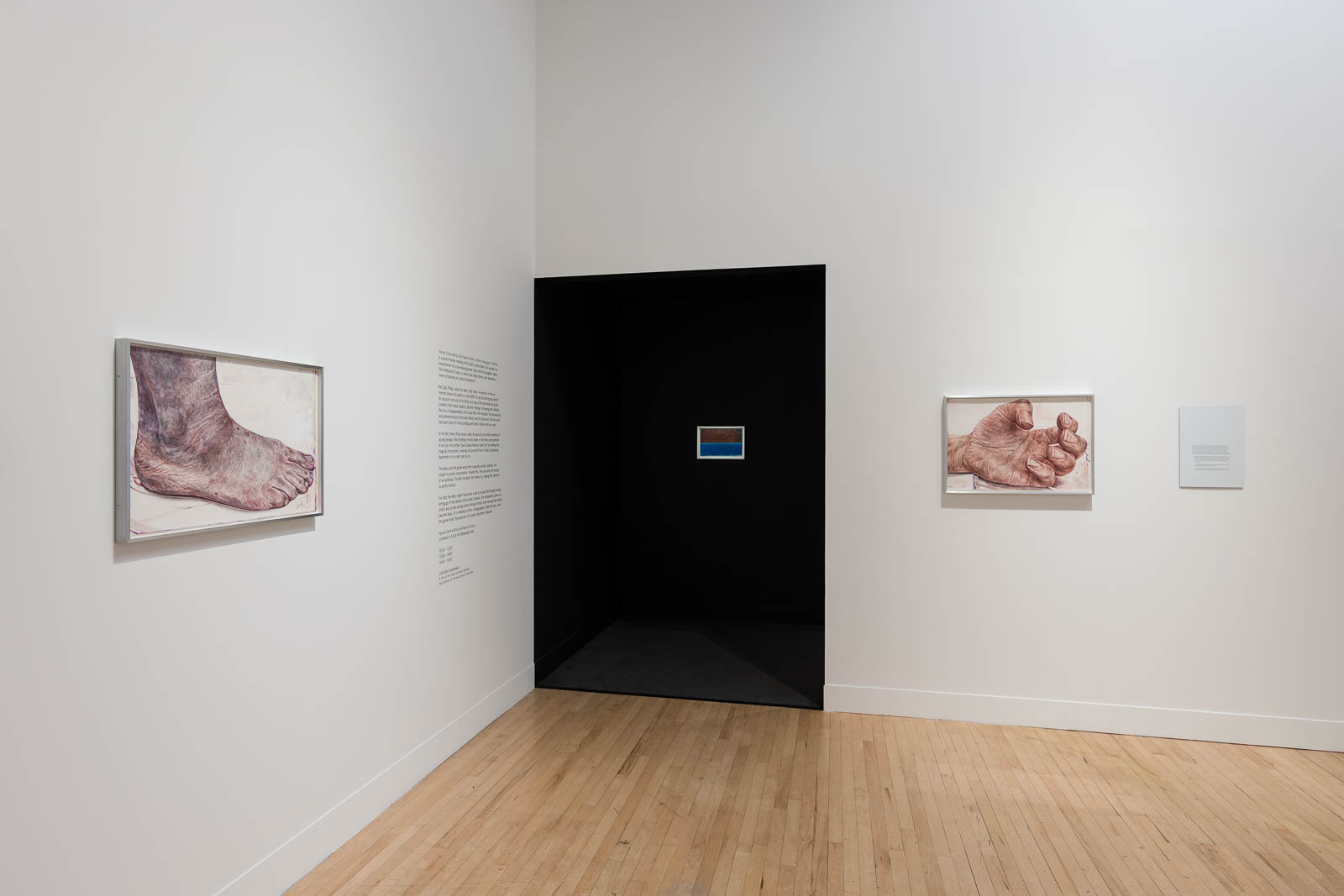
(Left) Untitled, 2022 Ink, bleach and pencil on watercolour paper I paint and draw my own hands and feet. More impassive evidence, more looking at myself. These drawings and paintings are truthful things, faithful representations that reveal little. The generic 'foot-ness' of a foot. An excess of truth then, made available by the same kind of failing artifice that aims to convince. But the lack of life begs the point. Perhaps they explore a technology of representation that seeks to conceal through revelation. I wanted to conjure intimacy, ugliness, fidelity and obscurity – a history of overly striving image-making. (Right) Sky News, 2016 Video and sound Sky News is a muted live-stream of the 24-hour television news channel. Without sound or subtitles, the everyday activity of watching the news becomes a detached exercise in observation and interpretation. It produces a kind of readymade banality, the 'liveness' predicated on a mutating, mediated construction of reality. In this way, the work also exhibits perpetual death.
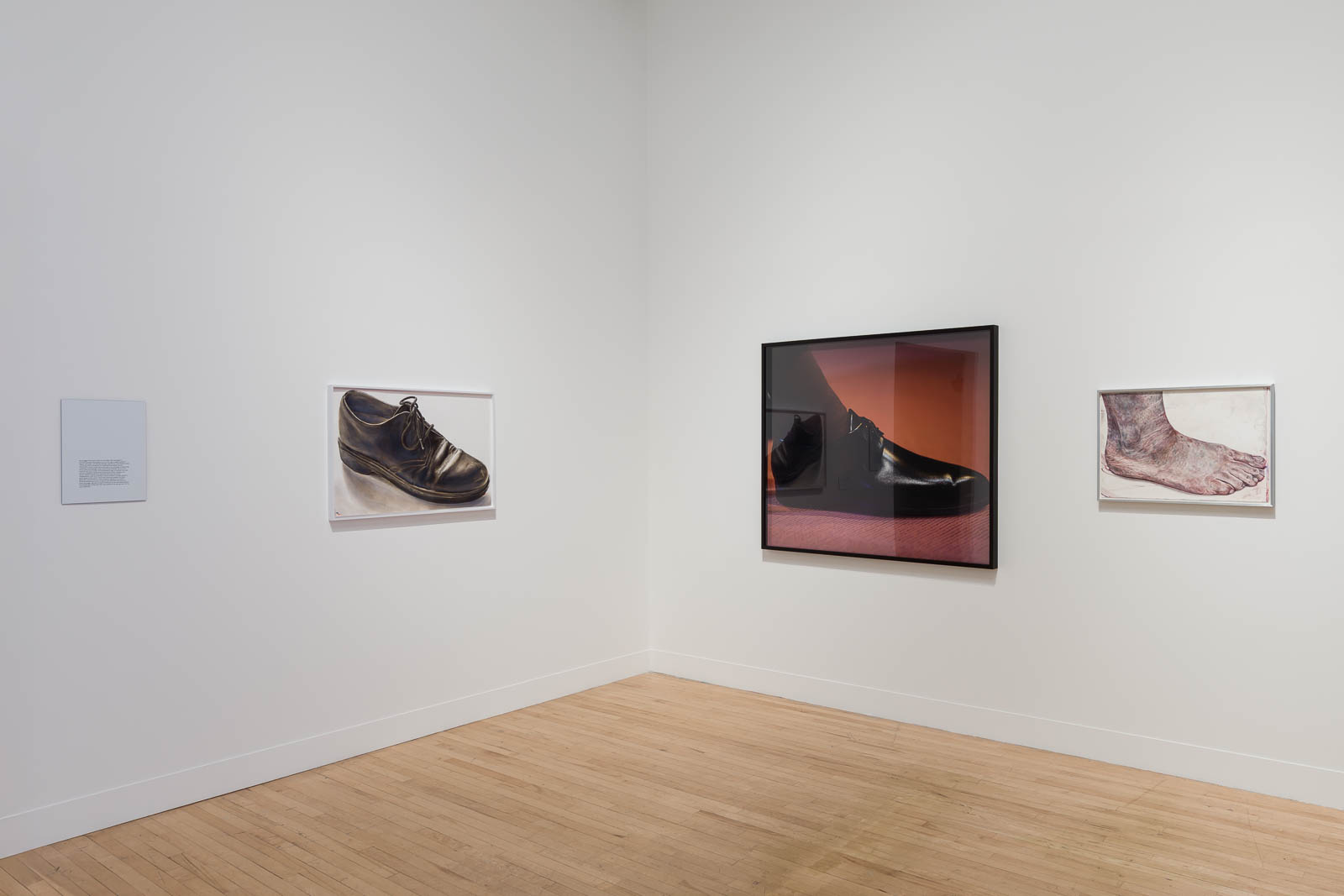
(Centre) Untitled, 2022 Digital print on dibond This print is the right shoe of the computer-generated interviewer from The worm. I like the way it looks here, next to a painting of my naked foot. It shrieks the various artifices stacked on whatever my foot is: painting, photography, computer-generated mesh, shoe? The still from the video has been upscaled with the (now-superseded) image enhancing software Topaz Gigapixel. A lot of the more pointless, microscopic detail was dreamt up by the AI.
From a diary by Philip Atkins and a game by Hollis Pinky Brockbank Atkins
Starring Toby Jones and Saskia Reeves
Nurses come and go, but none for me is a film in two parts. The first is a performative reading of my Dad's cancer diary. The second is a reenactment of a role-playing game I play with my daughter called The Ambulance Game, in which she feigns illness and demands a series of fantastical medical treatments.
My Dad, Philip, called his diary 'Sick Notes'. He wrote it in the six months before his death in June 2009. It's an astonishing document. An account not only of his illness but also of the personal and public contexts that shape a body's decline. Feelings of longing and self-pity, the loss of independence, the social life of the hospital, the bureaucracy and administration of terminal illness, and the discovery that he is and has been loved. It's excruciating and funny, tedious and very sad.
In the film, Peter (Toby Jones) reads the diary to an invited audience of young people. After finishing, he lies down on the floor and pretends to be sick. His partner Claire (Saskia Reeves) treats him by feeding him magical concoctions, covering his face with Post-it notes, discovering diamonds in his vomit, and so on.
The diary and the game were both originally private creations, not subject to public consumption. Despite this, they presume the fantasy of an audience. The film literalises the fantasy by staging the creations as performances. For Dad, the diary might have been a way to reclaim life through writing, letting go of the details of the world. Similarly, The Ambulance Game is a child's way of play-acting control through illness and enjoying that control. Like the diary, it's a rehearsal of the unimaginable. Unlike the diary, once the game ends, the question of recovery becomes irrelevant.
Featuring: Bella Aubin, Caroline Elms, Misheck Freeman, Chengxi Fu, Alfie Jallow, Tom Lyons and Ayesha Ostler.
Producer: Pinky Ghundale; Director of Photography: Oliver Curtis BSC; Music: Derek Baron; First Assistant Camera: Ben Foat; Second Assistant Camera: Luca Parasiliti-Holt, Tamara Turoczi; Grip: Michael Farrell; DIT: Andrew Elvis; Video Assist: Nico Corfield; Gaffer: Harry Wiggins; Electrician: Sami Hussein; Spark Trainee: Aggi Mentel, Toby Norman; Production Design: Tim Adams; Props Runner: Monika Saleh; Costume Designer: Teddy George-Poku; Hair and Make-Up Artist: Solange Koniak; First Assistant Director; Second Assistant Director: Lynn El Safash; Production Runner: Karla Hunter; Sound Recordist / Mixer: Andy Paddon; Boom Operator: Andrea Cremonini.
Thanks to Rosemary Atkins, Harry Atkins, Hollis Pinky Brockbank Atkins, The Master Shipwright's House, RADA, Klore & Soan Catering.
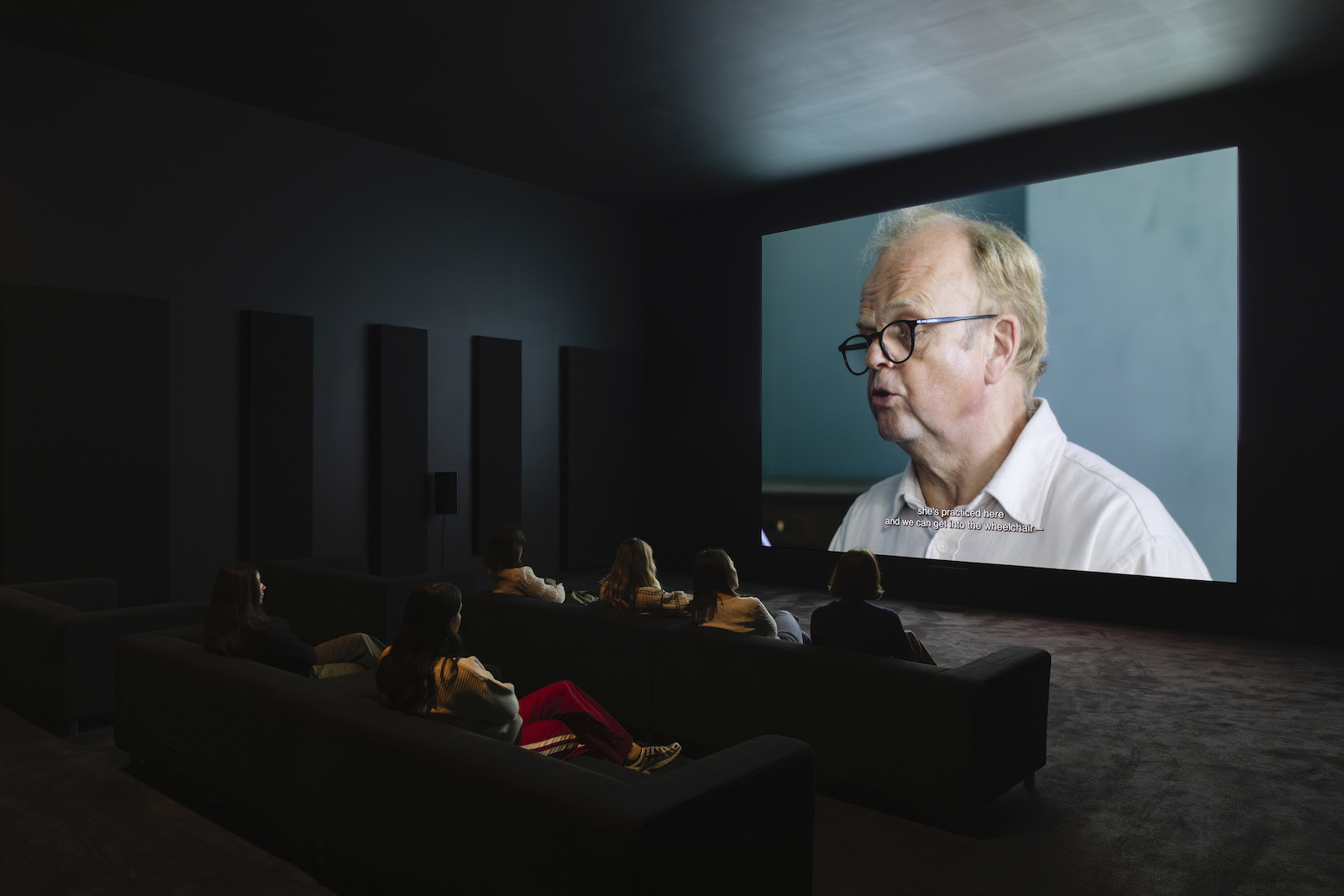
Ed Atkins and Steven Zultanski Nurses come and go, but none for me, 2025 Digital video (colour, sound) 2 hours, 2 minutes, 13 seconds Edition of 8 + 2AP
Copenhagen
at Cabinet, London
2 June - 22 July 2023
Installation Views
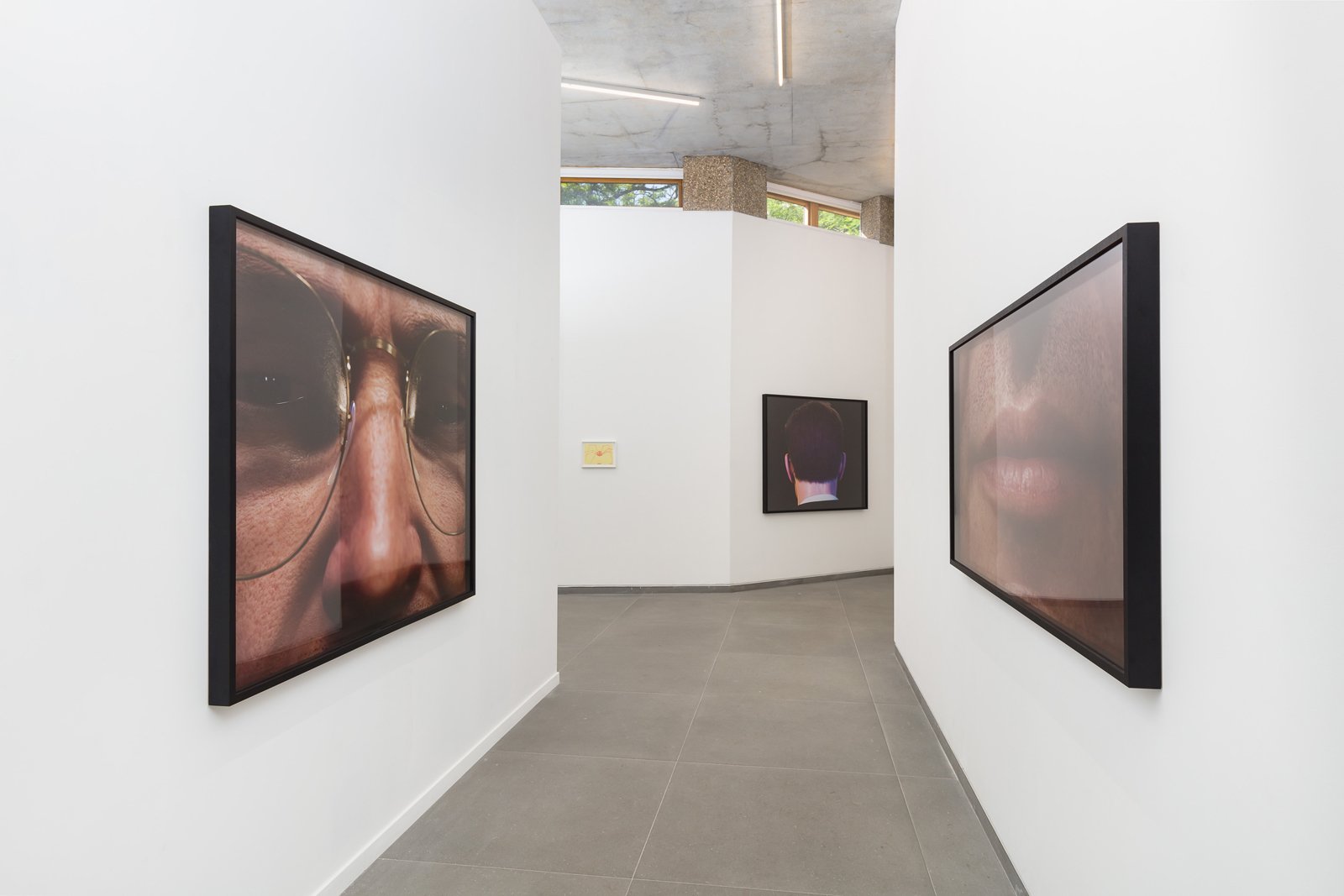
Ground Floor Gallery - Untitled, Children, Copenhagen



❮ ❯






.jpg)
.jpg)
.jpg)


